How to Lift Objects Safely
To lift a heavy object, plan the lift, stand with one foot forward, hug the load, bend slightly at your back, hips and knees and turn with your feet, as HSE’s workplace guidance sets out.

For a house move, this guide sets out the Health and Safety Executive’s (HSE) workplace lifting technique, then helpers, stairs, long days and what to leave to the crew.
In short
How do you lift heavy objects?
Lift a heavy object the way HSE’s workplace guidance on good handling technique sets out: plan the lift, set your feet, hug the load, bend slightly at your back, hips and knees, lift smoothly without twisting, and put it down before you adjust it.
The lift, step by step
- Plan the lift. Know where the load is going, use a handling aid if you can, decide whether you need help, and clear the way first.
- Feet apart, one forward. Beside the load if it is on the floor, ready to move your feet. Overtight clothing or unsuitable footwear can make this hard, HSE notes.
- Hug it close. Hugging the load may be better than gripping it tightly with just your hands. Keep it close to your waist, heaviest side in, and lift no more than you can easily manage, as our box guide sets out, citing HSE.
- Slight bend. At your back, hips and knees, not a stoop or a deep squat.
- Head up, no twist. Look ahead once the load is held securely, turn with your feet and move smoothly.
- Put down, then adjust. Set it down first, then slide it into place.
Good technique is no substitute for lifting aids or an easier job, HSE says.
From our crews: “the first things we ask about are floors, stairs and lifts at both addresses,” says our Hove flat move story.
Should you bend your knees or your back when lifting?
Both, slightly. HSE’s guidance is that, at the start of the lift, a slight bend of your back, hips and knees is better than either stooping (bending your back right over) or a full, deep squat. A deep squat can put excessive load on the knees and hips, adds L23, HSE’s fuller guidance.
From the floor to a shelf
- Slight bend to start.
- Legs start the rise. Once you start to lift, don’t let your back bend any further. HSE says this can happen if your legs straighten before the load starts to rise, and its fuller guidance says to start the movement with the strong leg muscles while keeping the back posture constant.
- Rest it mid-way. For a lift from floor to shoulder height, HSE suggests resting the load on a table or bench to change your grip.
“There is no single correct way to lift,” L23 adds.
How do you test a load before you lift it?
HSE’s guidance suggests testing an unfamiliar load before you lift it: rock it from side to side or try raising one end, and apply force gradually. If you feel too much strain, find another way to move it.
Read the load first
- Rock it first.
- Heavy side first. If one side is heavier, approach from that side, even if that means turning the load round, HSE says.
- Awkward counts too. An unwieldy load raises the risk even when it is light.
- Gloves that suit the load. The wrong gloves can make a load harder to hold, HSE notes.
From our crews: a crew that packs a house carries those boxes itself, which our Chichester to Salisbury story calls “a powerful argument for filling them evenly and keeping them liftable”.
How heavy is too heavy to lift on your own?
There is no single figure. HSE’s guidance says that, because so many things affect the risk, there is no weight at which lifting changes from ‘safe’ to ‘unsafe’; its simple guideline weights are in our box guide. HSE asks about four things: the task, the load, the working environment and the person (its pushing-and-pulling guidance shortens these to TILE).
When the simple figures stop
- First check only. If a lift involves twisting or is repeated more than once every two minutes, HSE says a more detailed assessment is needed.
- Not a target. Even lifts within HSE’s figures should be avoided or made less demanding where reasonably practicable, L23 says.
- Twice is serious. HSE’s guidance warns that loads above about twice its guideline figures may be a serious risk even for fit, well-trained people in good conditions.
HSE also says its figures need a closer look for anyone at higher risk, such as someone pregnant or with a recent injury or a significant health problem.
How do you move heavy furniture by yourself?
If you do move heavy furniture yourself, pivot or slide it rather than lift it, and leave anything you would have to force to the crew. Where other ways of making a job easier are limited, HSE’s guidance says moving a load by rocking, pivoting, rolling or sliding it is preferable to lifting it. Pushing or pulling furniture without wheels is likely to be harder work than moving something on wheels, L23 notes, and uncontrolled sliding or rolling of large or heavy loads can bring other risks.
Along the floor, not off it
- Pivot one end.
- Even floor. Uneven surfaces can dramatically increase the force needed to start a load and keep it moving, L23 says.
- Hands hip to shoulder. HSE’s workplace filter treats a push or pull as likely to be low risk when the force comes from your hands, your body is mostly upright and not twisted, your hands are between hip and shoulder height, and you pause at least every 20 metres or so.
- Fingers clear. Trapped hands are a common pushing and pulling injury, L23 says.
From our practice: antiques are the exception; our antique furniture guide explains why.
Do sack trucks and trolleys make lifting easier?
HSE’s first fix is mechanical help, such as a sack trolley or hoist. It reduces the handling but doesn’t remove it: you still have to move the aid and steady the load on it. Our washing machine guide quotes HSE on the effort saved.
Loading a sack truck
- Heaviest at the bottom. Stacked so you can see over it, and secured if necessary.
- Right wheels. HSE asks whether the wheels suit the surface and run freely.
- Slopes add force. More force is needed to push a load up a slope, L23 says.
- Rated load. Never load it past what it is rated to carry.
From our practice: “Our crews bring the sack truck, straps and blankets,” says our fridge guide.
How do two people lift something heavy together?
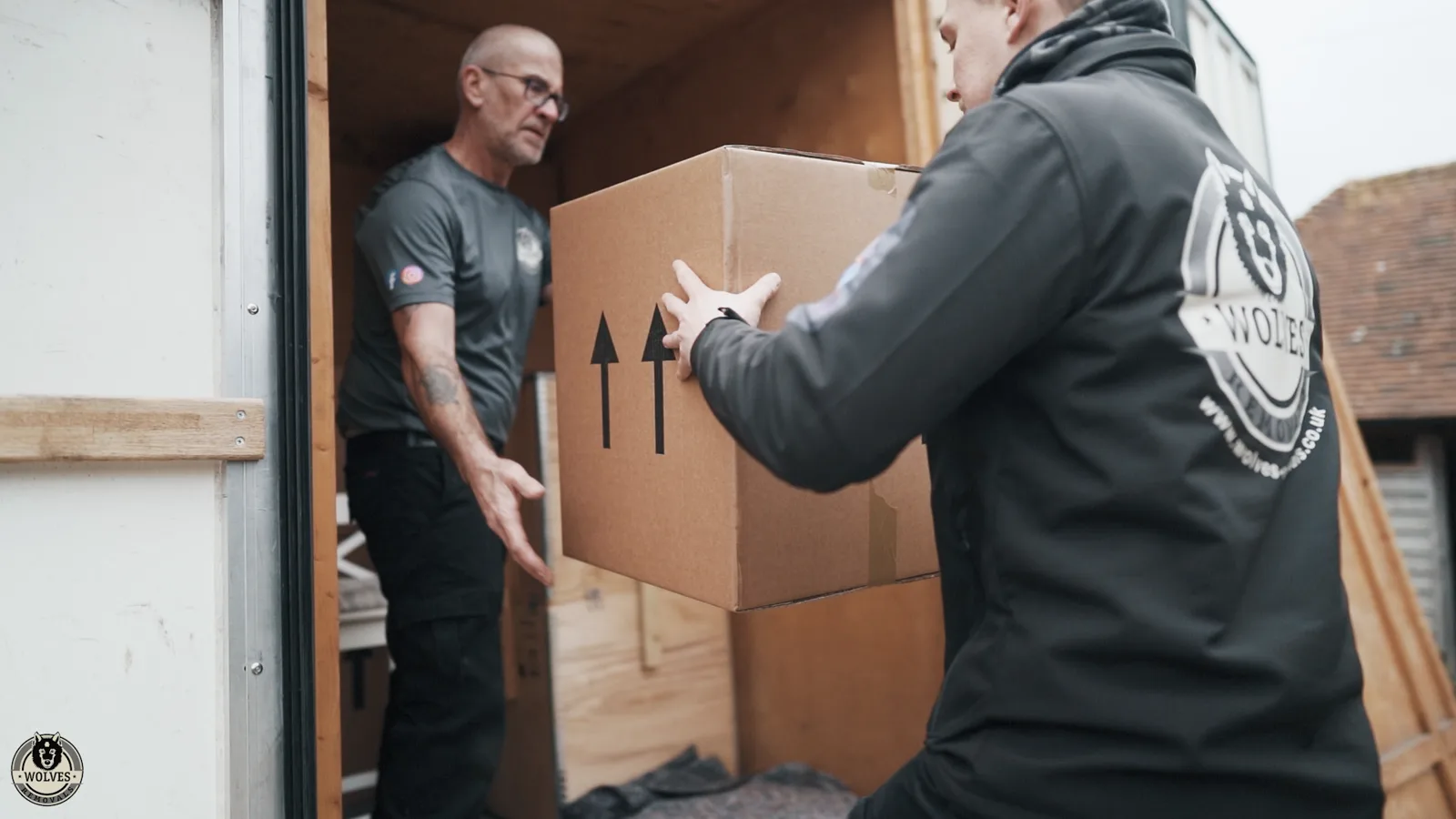
Agree a count before you lift. HSE warns that an unco-ordinated team lift may leave one person bearing the entire weight. How much a pair can share, and who should call the moves, are in our spiral staircase guide.
Lifting with helpers
- Count first. “One, two, three”, then lift together.
- Stronger lifter, heavy end. If the weight is uneven, HSE says the stronger people should take the heavier end.
- A small team. Teams of more than four are unlikely to work well unless managed very carefully, L23 says.
- Brief every helper. One-off lifts by whoever happens to be around can be harder to do well, L23 says.
From our crews: on our Brighton seafront antiques move, plaster pieces were “carried upright by more hands than the weight alone would need”.
How do two people carry a bulky load up and down stairs?
HSE’s guidance is to avoid carrying loads on stairs where you can. If you must, light the stair and keep a view past the load. Who takes the weight on a stair, and why a two-handed carry is harder there, are in our mattress guide.
Team carries on stairs
- Lights on. Poor lighting on stairs can make height and distance harder to judge, HSE says.
- See past the load. A bulky load can block your view, HSE says. Agree a count before the first step.
- Landings clear. So there is “somewhere to turn and rest a load”, as our Hove move story puts it.
- Ladders: light things. HSE’s guidance says not to plan to move loads up or down ladders, and to carry only light materials and tools when using one.
From our crews: “On a flat move, most of the day’s work is on the stairs,” the Hove story says.
How do you clear the route before you carry?
Walk the route first and remove anything that would make you stop, step over or turn. HSE’s assessment chart for carrying at work marks a route with steps, a steep slope, closed or narrow doorways, trip hazards, or bends and corners as higher risk. Two or more of those, or a ladder, puts the carry in its red band.
A clear way to the van
- Doors held open. Inside your own home only. HSE notes that holding doors open can make carrying easier and saves stopping and starting.
- Nothing underfoot. No bumpy, obstructed or slippery floor.
- Shortest carry. HSE’s fixes include reducing carrying distances.
From our practice: arranging parking on the day is down to you, and as our moving-day FAQ says, “Get it right and the crew loads metres from your door”.
How do you pace yourself on a long moving day?
Pace a moving day with breaks, changes of job and fewer floor-level or overhead lifts. HSE’s L23 says prolonged effort brings fatigue, which raises the risk of injury, and recommends breaks or switching to a task that uses a different set of muscles.
A long day, in turns
- Breaks.
- Switch tasks. Labelling or wrapping between heavier lifts.
- Off the floor. HSE’s guidance is to avoid lifting heavy loads from floor level.
- Nothing overhead. Lifts that start or finish above head height are worse than above shoulder height, HSE says.
From our crews: “Get it wrong and every item gets carried further, all day,” says our Perthshire move story of where the lorry is set.
How do Wolves Removals crews prepare to carry?
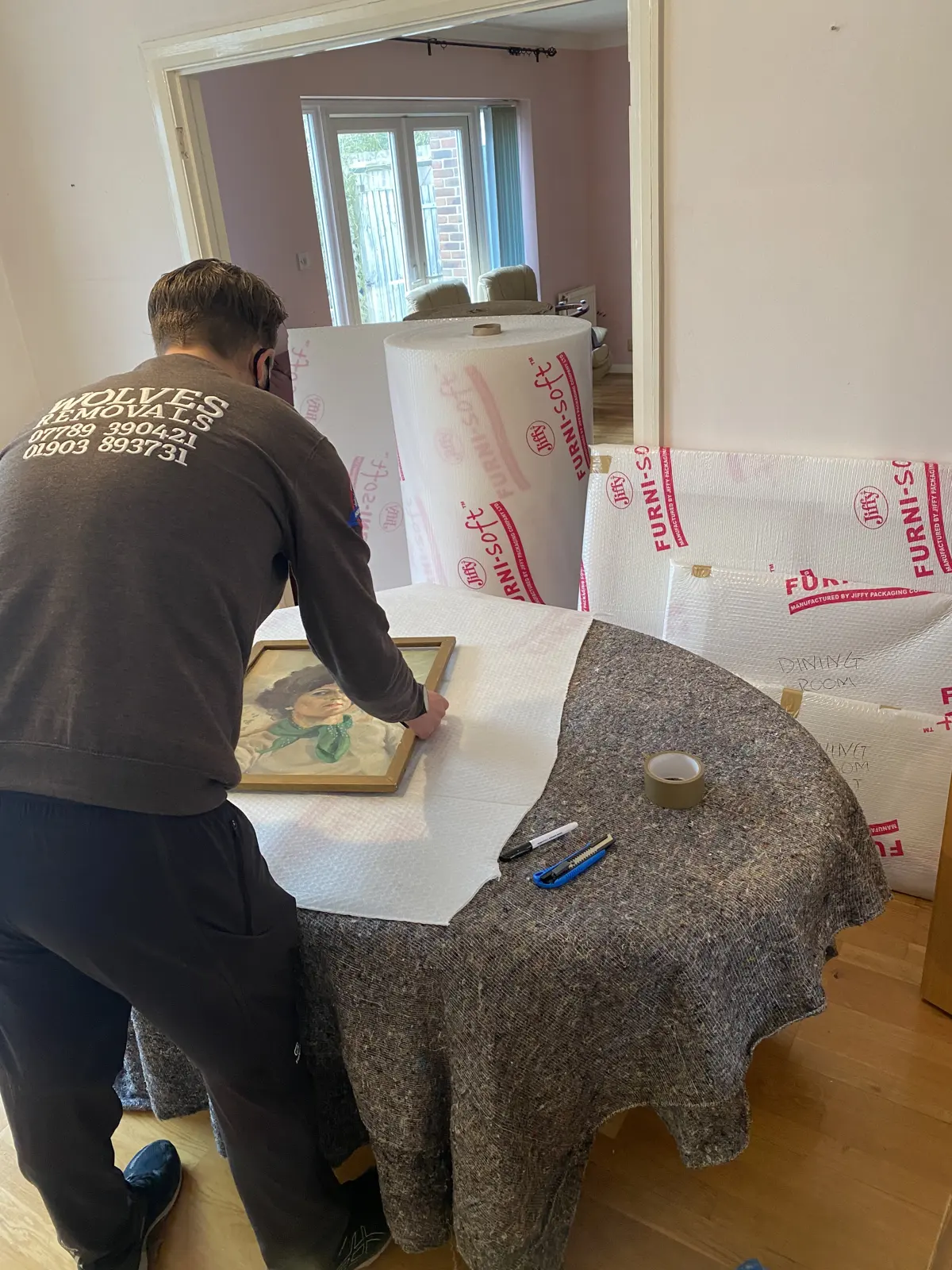
All Wolves staff “have completed our personal training programme and health & safety training”, and our FAQ on crew training lists what it covers, starting with “lifting technique, floor and doorway protection, wrapping and stacking”.
Before anything is carried
- Route protected first. On our house removals, “floor runners, banister and corner padding, and door guards go in before anything is carried”.
- Blankets and straps. Part of the “protective materials” our pricing page lists.
- Crew size planned. “Generally a crew of 2–4 movers is sufficient for most home moves,” our FAQ on crew size adds.
What should you leave to the removal crew?
Leave anything you would have to force. Our FAQ on dismantling furniture calls anything “genuinely awkward, from a piano to a garden statue” a “specialist job rather than an improvisation”.
Items with their own page
- Fridge freezer. How a fridge freezer is carried.
- Washing machine. You or your plumber disconnect it; our crew carries, protects and places it (washing machine guide).
- Wardrobe. Not one to move alone.
- Mattress. How to carry a mattress.
- Piano. When a piano needs more than two people, and our piano moving.
- Antiques. Our guide to moving antique furniture and our antiques moving service.
- Sofa. If it won’t fit, a window came out to get one in.
A longcase clock has its own grandfather clock guide.
About this guide. Sources, read 16 November 2026: HSE guidance on the Manual Handling Operations Regulations 1992 (which apply in Great Britain), the Regulations on legislation.gov.uk, and the NHS website for England. General information, not medical advice.
Your next steps
- Get a removal quote.
- Try the removals calculator.
- See our full packing service.
Jack Wolfe
Director, Wolves Removals · Ashington, West Sussex
Jack runs Wolves Removals, which has moved families and businesses across West and East Sussex, Surrey, Hampshire and Kent since 2016 from its Ashington base. The firm is fully insured, Checkatrade-verified and a LAPADA Approved Service Provider for antiques and fine art. More about us, or read our reviews.
How to Lift Objects Safely — FAQs
HSE’s workplace guidance doesn’t say pushing is better than pulling, or the reverse; it gives the same guidance for both. Getting a load moving, or changing its direction, usually takes noticeably more force than keeping it moving, so avoid stop-start.
Not for a householder moving their own belongings. The Manual Handling Operations Regulations 1992 put duties on employers (and some self-employed people) to protect people at work. HSE’s guidance on them still sets out how to lift and carry, so we draw on it here.
The NHS says back pain, particularly lower back pain, is very common, and usually improves within a few weeks but can sometimes last longer or keep coming back. Its advice is to stay active, and to see a GP if it does not improve after treating it at home for a few weeks. Ask for an urgent GP appointment or get help from 111 if you “feel hot, cold, shivery or generally unwell” or “it’s severe pain that starts suddenly, or it’s getting worse quickly”, the NHS says; its back pain page lists when to call 999.
If you’re pregnant, the NHS page on back pain in pregnancy advises avoiding lifting heavy objects, and bending your knees and keeping your back straight when you pick something up from the floor.