How to Move a Fridge or Fridge Freezer
Three questions decide whether a fridge survives a house move: how long you leave it standing before switching it on, whether it can travel on its side, and whether it will physically pass through the door.

The first has no single answer, because Hotpoint, Beko, Bosch and Samsung all publish different waiting times. Here is what each of them actually says, and what we do on a move day.
How Long Should You Leave a Fridge Freezer Before Switching It On?
Stand it upright, leave it unplugged, and wait. If it travelled upright the wait is short. If it travelled on its side it is a good deal longer, and the number you want is the one in your own manual, because the four brands most people own do not agree with each other.
These are the manufacturers' own published figures, not a rule of thumb:
- Hotpoint — at least two hours upright after any move, and at least eight hours or overnight if the appliance travelled on its side.
- Beko — at least four hours standing unplugged and upright after moving, whatever position it travelled in.
- Bosch — a minimum of three hours upright before switching on, where the appliance has been laid on its side.
- Samsung — two to three hours if it was carried upright, at least four hours if it was laid down.
So the honest answer to how long to leave a fridge after moving is somewhere between two and eight hours depending on whose appliance you bought and how it travelled. Every guide that gives you one universal number is guessing on your behalf. Find the manual, or search your model number and the word settling.
If you want a single safe default while you look, stand it upright overnight. Nobody's manual asks for longer than that, and no fridge has ever been harmed by waiting.
Why the Wait Actually Matters
It is not superstition, and it is not about the food. It is about oil.
The compressor is the pump that drives the whole cooling system, and it runs in a bath of oil that lubricates it. Tip the appliance over, or shake it about in the back of a vehicle, and some of that oil can migrate out of the compressor and into the narrow refrigerant lines where it does not belong. Beko's own explanation is blunt about the consequence: switch on too early and the displaced oil can block the refrigeration system.
Standing the appliance upright lets gravity put the oil back where it belongs before the compressor is asked to work. That is the whole mechanism. A blocked system is not a repair most people want to pay for on the week they have moved house.
Worth knowing separately: Hotpoint note that even once it is running, a fridge freezer can take up to twelve hours or overnight to pull down to a temperature where it is safe to restock food. The settling wait and the cooling wait are two different clocks, and they run one after the other. Plan your first food shop around that, not around the moment you plug it in.
Can You Move a Fridge Freezer on Its Side?
Yes, but it is the second choice, and one position is ruled out entirely.
Bosch ask you to keep the appliance upright if at all possible. Hotpoint allow it on its side but are explicit that it must never travel on its front or its back, because that is where the damage happens. Upright is best, side is acceptable, front or back is not.
There is a practical reason to try hard for upright beyond the compressor. A fridge freezer laid on its side puts its whole weight onto a door, a hinge line and a set of shelf runners that were never designed to carry it. You can win the oil argument and still arrive with a door that no longer seals.
If it does have to go down, note the time it went down. The longer it spent on its side, the longer you stand it up afterwards.
What to Do the Day Before
This is the part that catches people out, because a fridge cannot be prepared on the morning of a move. It needs a head start.
Run the contents down over the preceding week rather than trying to rehome a full freezer the night before. Switch it off and empty it the day before, not the day of. If it is not frost free it has to be defrosted, and Hotpoint's guidance is clear that this needs doing before it travels. Beko go further and ask that the appliance has come back to room temperature before it is moved, which they note can itself take several hours.
A defrosting fridge freezer produces a surprising amount of water. Put towels down and check them, because the puddle tends to appear under the unit rather than in the tray where you were watching for it.
Then take the shelves, drawers and door balconies out and pack them separately. Glass shelves in a moving appliance are the most commonly broken part of the whole job, and they cost more to replace than most people expect. Tape the doors shut afterwards, or strap them, so nothing swings open on a staircase.
Moving It on the Day
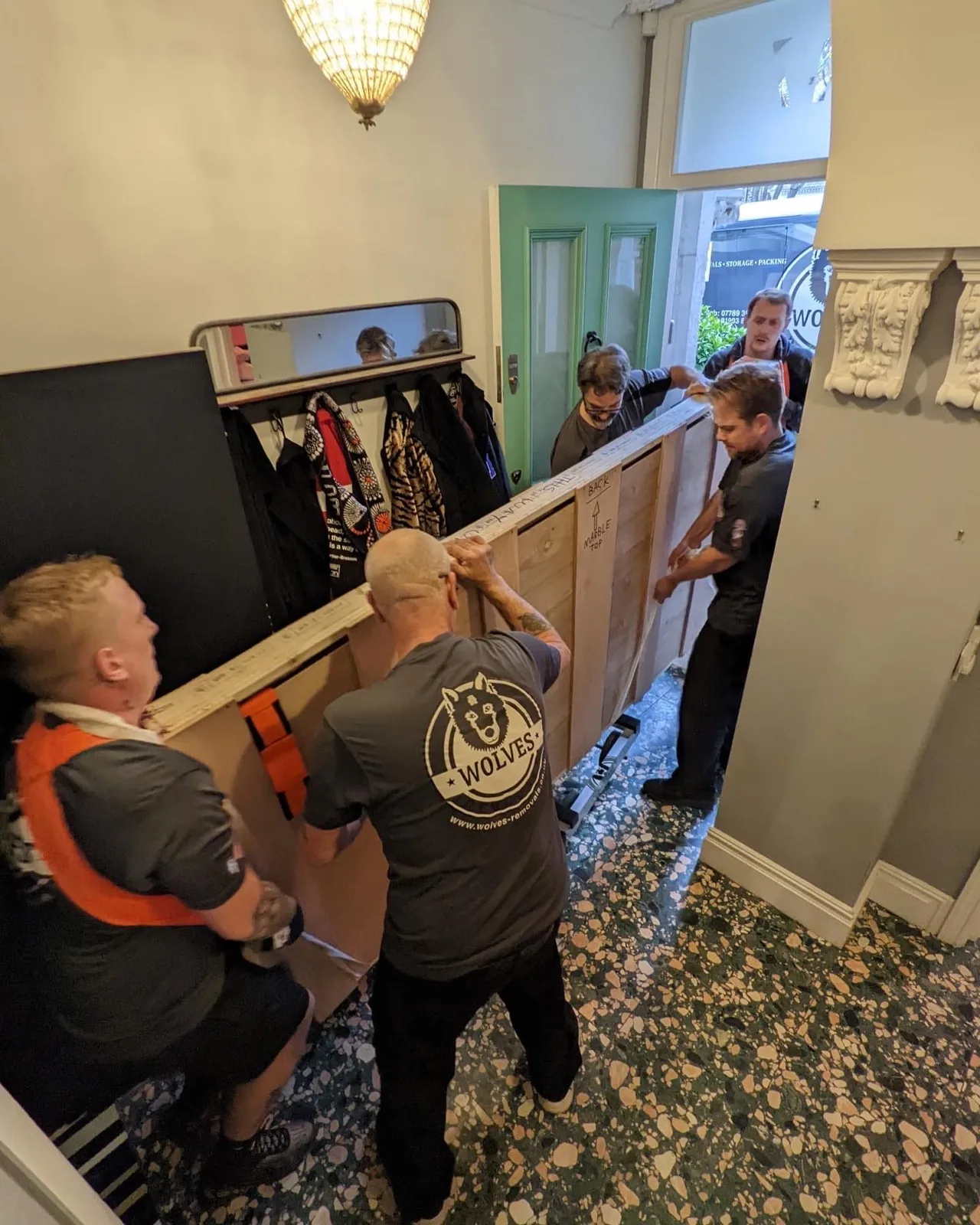
Clear the route before the appliance leaves the wall. That means the whole route, front door included, and it means putting floor protection down first rather than discovering halfway that you needed it.
A full size fridge freezer is a two person lift and an awkward one, because the weight sits high and the thing has no honest handholds. A sack truck with a strap is the right tool, taken up against the side of the appliance rather than a door, with the load tipped back onto the wheels and controlled rather than balanced.
Two details that save floors. Never drag it, because the feet will score a wooden floor in one pass and the mark does not come out. And lift it over thresholds rather than bumping it down, because a bump with that much weight behind it goes through vinyl and cracks tiles.
In the vehicle it wants to be upright, strapped to a side rail, and blanketed at any point where it can touch anything hard. Load it late and unload it early, so it is not carrying the weight of the load behind it and so it gets the longest possible standing time at the other end.
Will It Actually Fit? Doorways, Stairs and American Fridge Freezers
Measure before moving day, because this is the question that stops a move dead, and the numbers are not reassuring.
The most common internal door in England and Wales is 1981mm by 762mm. Scotland more often uses 2040mm by 726mm.
Those are the door itself, and the clear opening you can actually pass something through is narrower still once the frame and any stop beading are in the way. Wolves Removals
Now the appliance. LG give the typical range for their American fridge freezers as 900mm to 913mm wide, 1790mm to 1795mm tall, and 700mm to 735mm deep. Multi door models can be wider again.
A 900mm appliance does not pass a 762mm doorway face on. There is no technique that closes a gap of that size. What has to happen instead is that the unit goes through at an angle on its depth, which is where the 700mm to 735mm figure earns its keep, and that only works if the hallway beyond is wide enough to turn in. Sometimes the doors come off the appliance. Sometimes the door and the frame stop beading come off the house.
The measurement most people forget is not the doorway at all. It is the turn at the bottom of the stairs, and the height of the ceiling over the first flight if the appliance is going up.
Integrated Fridges Are a Different Job
An integrated fridge is fixed into the run of units and carries a cabinet door on sliding or fixed hinge brackets. It is not a case of pulling it out.
The cabinet door comes off first, then the appliance unbolts from the carcass, and both the brackets and their fixings need to go in a labelled bag or the unit cannot be refitted at the other end. If the new kitchen was not built around the same appliance, an integrated fridge frequently does not go back in at all, which is a thing worth knowing weeks before the van arrives rather than on the day.
Plumbed in models, usually American ones with an ice maker or water dispenser, have a water feed behind them. That needs isolating and disconnecting properly, and the line drained, before anything moves.
What Goes Wrong
Four things, in the order we see them.
The appliance is still cold and still full, because nobody started the day before. The glass shelves travelled inside the unit and one of them did not survive. The floor got scored on the way out, usually within a metre of where the appliance had been standing. And somebody plugged it in the moment it arrived, because the kitchen looked finished and the wait felt like fuss.
None of those are difficult to avoid. All four are ordinary.
What a Crew Does Differently
Honestly, most of it is sequence rather than strength.
We measure the route before anything is disconnected, protect the floor along the whole of it, take the doors and shelves off rather than trusting tape, and carry the appliance on a strapped sack truck with two people on it. Wolves Removals
The part that matters most is the boring part. It goes on the vehicle upright, it comes off early at the far end, and it goes to its final position straight away so the standing clock starts as soon as possible. By the time the rest of the load is in, most of the wait has already happened.
What we will not do is disconnect a hard plumbed water supply or anything gas fed. That is a job for the relevant trade, and we would rather say so in advance than improvise in somebody's kitchen.
If your move involves a kitchen full of appliances, our house removals page covers what a survey looks at beforehand, and our full packing service page explains how the rest of the kitchen gets boxed.
The Wolves Removals Team
Family-run removals · Ashington, West Sussex
We have moved families and businesses across West and East Sussex, Surrey, Hampshire and Kent since 2016, from our Ashington base. We are fully insured, Checkatrade-verified and a LAPADA Approved Service Provider for antiques and fine art. More about us, or read our reviews.
How to Move a Fridge or Fridge Freezer — FAQs
Between two and eight hours, depending on the brand and how it travelled, and the figure in your own manual is the one to follow. Hotpoint ask for at least two hours upright after any move and at least eight hours or overnight if it was laid on its side. Beko ask for at least four hours. Bosch ask for a minimum of three hours upright where the appliance has been on its side. Samsung ask for two to three hours after an upright move and at least four hours after a flat one. If you cannot find the manual, stand it upright overnight and plug it in the next morning. No manufacturer asks for longer than that.
No. Hotpoint's guidance is explicit that a fridge freezer should never be transported on its front or its back, because that is the position most likely to damage it. Upright is the position manufacturers prefer, and on its side is the accepted alternative when upright is not possible. Laying it flat also puts the full weight of the appliance onto a door and its hinges, which can leave you with a unit that cools perfectly well but no longer seals.
Only if it is frost free. A frost free appliance has no ice build-up to melt, so it can be emptied, switched off and moved without a defrost cycle. Anything that is not frost free needs defrosting before it travels, because the ice turns to water at some point and you would rather that happened on your kitchen floor with towels down than in the back of a vehicle. Beko also ask that the appliance has returned to room temperature before it is moved, which can take several hours on its own.
Do not drag it, and do not bump it over thresholds. The feet on a fridge freezer will score a wooden floor in a single pass and the mark does not polish out. Put floor protection down along the entire route before the appliance leaves the wall, then move it on a sack truck taken up against the side of the unit with a strap, so the weight sits on the wheels rather than on the feet. Lift it over any threshold rather than letting it drop, because that much weight landing on one edge is what cracks tiles and splits vinyl.
Yes, as part of a house move. A fridge freezer is a standard item on a domestic removal and it is handled like any other heavy appliance: emptied and defrosted by you beforehand, then shelves out, doors secured, floor protected and carried on a strapped sack truck by two people. What a removals crew will not do is disconnect a hard plumbed water supply to an ice maker or dispenser, or anything gas fed, as those need the relevant trade. Tell whoever surveys your move that there is a large or American style appliance, because it changes the access plan.
Start the evening before at the latest, and longer if the freezer has a heavy ice build-up. Defrosting is not a task that fits into moving morning: the ice takes hours to clear, the water arrives gradually, and Beko ask on top of that for the appliance to come back to room temperature before it travels, which can take several hours by itself. The practical approach is to run the contents down over the preceding week, then switch off, empty and defrost the day before the move with towels under and around the unit.