How to Move a Wardrobe
Dismantling a wardrobe is not free.

Every time a flat-pack carcass comes apart it goes back together a little looser, so the first question is not how to take it apart but whether you need to. That turns on one measurement most people never take.
Should You Dismantle a Wardrobe, or Move It Whole?
Whole, if it will physically go. Dismantling is what you do when access forces it, not a default, and the reason is that not every wardrobe survives being taken apart twice.
It comes down to how yours is built:
- Flat-pack. Cam locks and dowels driven into chipboard. Each one cuts its own seating the first time it is assembled, and every dismantle takes a little more of the board with it. A flat-pack wardrobe that has already been built once will usually go back together, but it goes back slightly looser. Take one apart three or four times and the carcass starts to rack.
- Solid or traditional. Often designed to come apart, with knock-down fittings, bolts or wedged joints, and frequently the easier of the two to dismantle and rebuild without loss. Older wardrobes in particular were built to be taken up a staircase in pieces.
- Modular systems such as IKEA PAX. Assembled in position and not really intended to travel built. If the frame will pass through the openings intact, moving it whole is kinder than stripping it.
- Fitted wardrobes. These are part of the building rather than part of the move. They are scribed to the wall and floor, and they do not come with you.
So the order is: measure first, and only reach for the screwdriver if the answer says you have to.
Will It Go Through? The Measurement Everyone Misses
Most people measure the wardrobe against the doorway. That is the easy half, and it is not usually what defeats the job.
A wardrobe is a rigid box. It goes through a door on its side, so width and depth decide whether it passes. But at the other end it has to be stood back up, and to swing a box from lying flat to upright you need vertical clearance equal to the diagonal of its side, not just its height.
The arithmetic is short. Square the height, square the depth, add them together, take the square root. A wardrobe 2.1 metres tall and 0.6 metres deep needs about 2.18 metres of clear height to be uprighted, not 2.1.
Now put that against a real room. Modern UK new builds average around 2.4 metres, and the national space standard sets a minimum of 2.3 metres over at least three quarters of the floor area, with London requiring 2.5 metres. The 2.4 figure is not an aesthetic choice, incidentally: plasterboard is made in 2.4 metre sheets. Victorian rooms are usually far more generous, commonly between 2.7 and 3 metres.
In a standard modern bedroom a tall wardrobe is therefore tight but workable. Under a sloping ceiling, in a loft conversion, or in a room with a low beam, it frequently cannot be stood up at all. That is the situation where a wardrobe gets carried all the way in, and then has to come all the way out again.
How to Dismantle a Wardrobe
Empty it completely first, including the top, which is where things get forgotten.
Then work from the outside in. Doors off at the hinges, with somebody holding the weight while the last screw comes out. Internal shelves and hanging rails out next, since most lift free.
The back panel is the step people skip: on cheaper units it is pinned or stapled on and has to be eased off carefully, because it is thin, it splits, and without it the carcass has no rigidity at all. Wolves Removals

Lay the carcass down before you take the frame apart, rather than working on it standing. A tall empty carcass with its doors off is top heavy and will go over.
Two habits make the rebuild painless. Photograph each stage as you go, particularly the back panel and the hinge positions. And put every screw, cam and dowel into one bag, then tape that bag to the largest panel. Fixings that travel loose in a box are the single commonest reason a wardrobe cannot be rebuilt on the first evening.
Mirrored and Sliding Doors Come Off First
Always, whatever else you decide about dismantling.
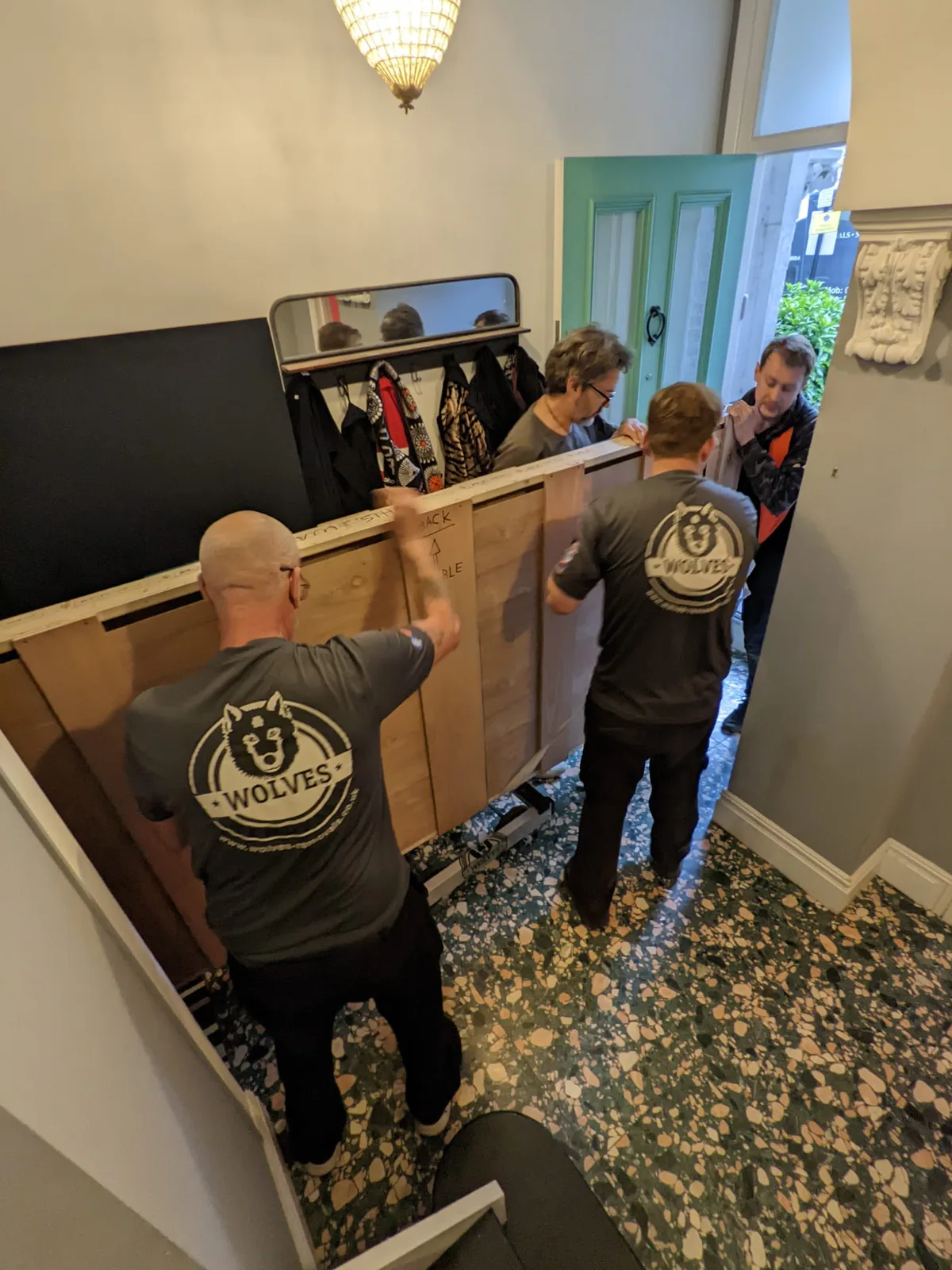
A mirrored door is heavy, it is glass, and it is hung on hinges that were sized for a door rather than for being carried. Sliding doors usually lift up and out of the bottom track at a slight angle, which is easier than it looks once the wardrobe is empty.
Once off, a mirrored door travels like a mirror: blanketed, taped across the face so a break stays contained, carried on edge by two people, and never laid flat where somebody can put something on it.
What to Do With the Contents
Hanging clothes go into wardrobe boxes, which have a rail across the top so everything transfers on its hangers and comes out ready to hang again. It is the one specialist box worth having, because the alternative is folding an entire wardrobe into cartons and ironing it all at the other end.
Do not move a wardrobe with the clothes left in it. The weight is considerable, it is all high up, and a carcass designed to hold that load standing still in a bedroom is not designed to hold it while being tilted through a doorway.
Protecting It in Transit
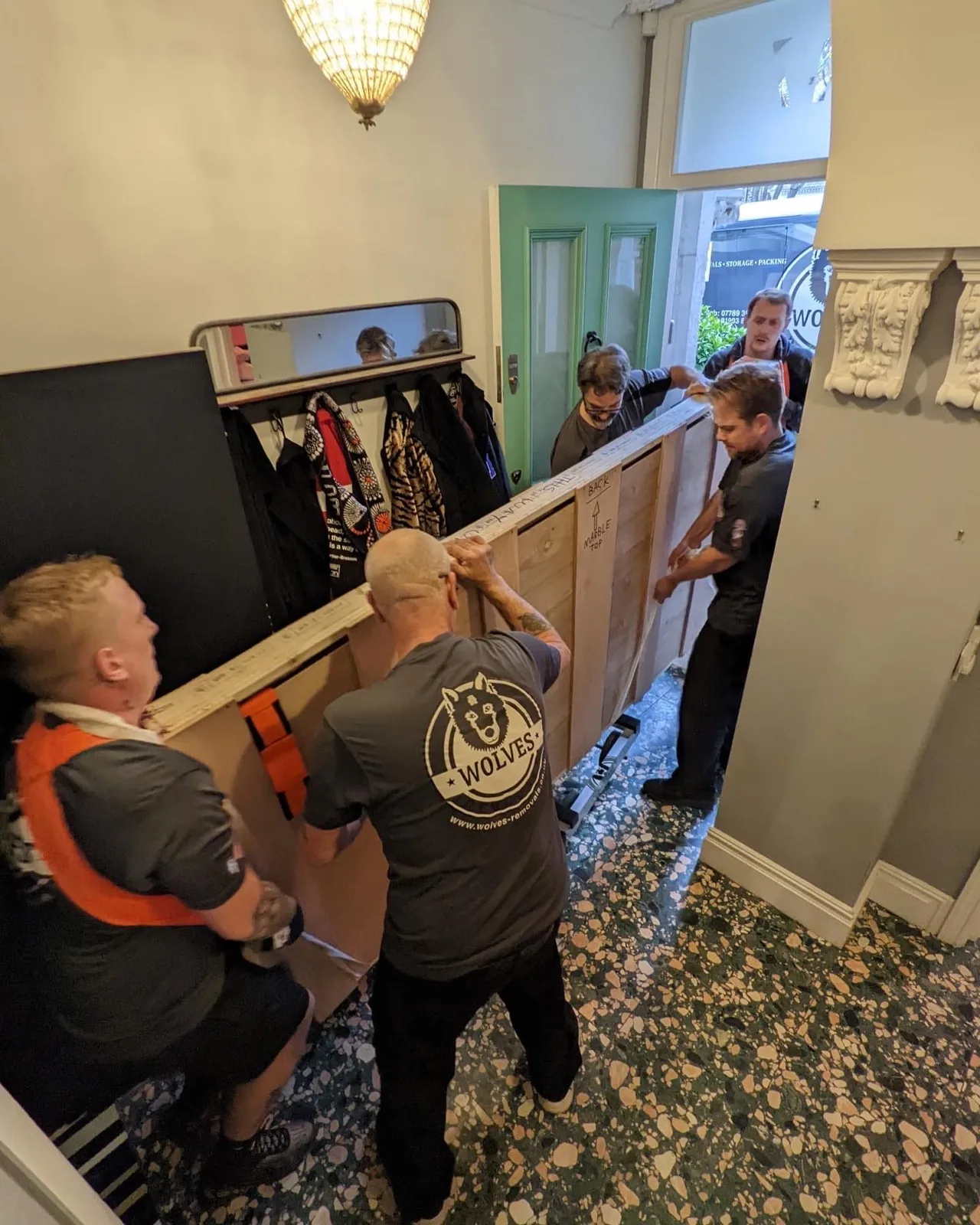
Corners and top edges take every knock, so that is where the blankets go. Wrap, then strap, and make sure the straps bear on a blanket rather than on the veneer.
In the vehicle a wardrobe wants to travel upright against a side, strapped to a rail, rather than laid on its back with the load piled on top.
If the doors are still attached, tape or strap them shut, because a door that swings open in transit takes the hinge and a piece of the carcass with it. Wolves Removals
What Goes Wrong
Four things, in the order we meet them.
The wardrobe went in whole and then would not stand up in the room. The back panel split coming off, so the rebuilt carcass is no longer square. The fixings went into a box rather than onto the panel, and the wardrobe spent the first night in pieces. And the mirrored door was carried flat by one person.
All four are avoidable with a tape measure and a freezer bag.
Do Removal Companies Dismantle Wardrobes?
Yes. Dismantling and rebuilding furniture is part of a household move rather than an extra service, so there is no wardrobe charge sitting alongside the job.
What a crew brings to it is judgement about which wardrobes should come apart and which are better moved whole, which is mostly a matter of having seen what happens to a flat-pack carcass on its third rebuild. The measuring happens before anything is unscrewed, the fixings stay with the panel, and the doors come off before the unit moves rather than after it has jammed.
Tell us at the quote stage if there is a tall wardrobe, a mirrored one, or a room with a sloping ceiling at the far end. It changes the access plan rather than the price. Our house removals page covers what a survey looks at, and if the bedroom is coming as a whole, how to move a mattress covers the rest of it.
The Wolves Removals Team
Family-run removals · Ashington, West Sussex
We have moved families and businesses across West and East Sussex, Surrey, Hampshire and Kent since 2016, from our Ashington base. We are fully insured, Checkatrade-verified and a LAPADA Approved Service Provider for antiques and fine art. More about us, or read our reviews.
How to Move a Wardrobe — FAQs
Only if access makes you. Dismantling is not free: flat-pack wardrobes are held together by cam locks and dowels seated into chipboard, and each time one comes apart a little more of the board goes with it, so the carcass goes back together slightly looser every time. If the wardrobe will pass through the doorways and can be stood upright at the other end, move it whole. Solid and older wardrobes are the exception, as many were designed to come apart and rebuild without loss.
Often, yes, and it is usually the better outcome. Empty it, take the doors off, and measure two things rather than one: whether it passes through the openings on its side, and whether there is enough clear height to stand it back up in the new room. That second measurement is the diagonal of the wardrobe's side, not its height. Square the height, square the depth, add them and take the square root. A unit 2.1m tall and 0.6m deep needs roughly 2.18m of clearance to be uprighted.
Empty, doors off, two people, and carried rather than dragged, with the weight low and the carcass tilted back rather than lifted flat. The obstacle is rarely the stairs themselves; it is the turn at the half landing and the headroom above the flight. Measure the turn before you start, because a tall carcass is a rigid box and it cannot be persuaded round a corner it does not fit. If the answer is no, that is the point at which dismantling earns its keep.
No. The load is heavy and it all sits high up, and a carcass built to hold that weight standing still in a bedroom is not built to hold it while being tilted through a doorway and carried down stairs. Hanging clothes go into wardrobe boxes, which carry a rail across the top so garments transfer on their hangers and come out ready to hang again rather than needing to be ironed at the far end.
Generally not. A fitted wardrobe is scribed to the wall, floor and often the ceiling, and it forms part of the building rather than part of your contents. Removing one is a carpentry job and what comes out is rarely reusable elsewhere, because it was cut to that particular space. If a fitted wardrobe is coming out as part of a renovation, treat it as building work that happens before the move rather than something the removal crew deals with on the day.
Yes, as part of a household move rather than a separate booking, so there is no extra charge attached to it. Doors come off before anything is carried, fixings are bagged and kept with the panel they belong to, and the unit is rebuilt at the other end. Mention a tall wardrobe, a mirrored one or a sloping ceiling in the new bedroom when you ask for a quote, because those change how access is planned rather than what the move costs.