How to Move a Grandfather Clock
A longcase clock travels as four separate things, never as one — the case, the movement, the pendulum and the weights — because the commonest breakage in a move is a snapped suspension spring, the thin strip of metal the pendulum hangs from.

Which clock you have decides how much of it you can safely take apart, and the move is not finished when the van leaves — it is finished when the case is level and the tick is even.
Never Move a Grandfather Clock in One Piece
The most common breakage in a clock move is a snapped suspension spring, the thin flat strip of metal the pendulum hangs from instead of a hook. It happens because a longcase clock is not one object: it is a case, a movement, a pendulum and a set of weights, and all four have to travel separately.
The spring connects the pendulum leader to the suspension post and lets the pendulum swing without friction. It is engineered to flex a few degrees with every swing, for as long as the clock runs, but not to take the weight of a swinging pendulum bob over a speed bump. Move a pendulum clock without removing the pendulum first and that strip is what gives way.
Entirely avoidable, and everything below follows from it.
First, Work Out Which Clock You Have
Before anything comes off, count the weights. It takes ten seconds and tells you most of what you need to know, because English longcase clocks fall into two families that behave differently during a move.
| 30-hour | 8-day | |
|---|---|---|
| Weights | One | Two, or three if it chimes |
| Driven by | Chain | Gut line or steel cable |
| Winding | Pull the cord by hand | A key, through holes in the dial |
| Striking | Count wheel | Rack and snail |
| After the move | Strike can be out of sequence | Corrects itself |
If you cannot see the weights, look at the dial instead. Winding holes mean an eight-day movement. A blank dial with no holes means a thirty-hour, wound by pulling the cord inside the case.
A count wheel is what surprises people a fortnight later. It keeps track of the hour by counting its own strikes, so if the striking is interrupted while the going train carries on, the strike drifts out of step with the hands and has to be put back manually. Dismantling a clock does exactly that. A rack and snail reads the hour straight off the hour hand every time it strikes, so it comes back correct from the first hour whatever you did to it.
Neither is a fault — but if a thirty-hour strikes nine at eleven o'clock the week after a move, nothing is broken.

Why the Case Is That Tall in the First Place
A longcase clock is tall because it houses a pendulum that beats once a second — the seconds pendulum, or Royal pendulum — and that means a case built for a pendulum about 0.994m long, just under thirty-nine and a quarter inches, giving sixty beats to the minute in step with a watch's second hand.
What made a metre-long pendulum practical was the anchor escapement, which appeared around 1670 and cut the pendulum's swing to roughly four to six degrees. A narrow swing meant the pendulum could be long, slow and accurate inside a narrow wooden trunk. Nearly every English longcase clock made between 1680 and 1900 works this way.
So the height is not decoration. You are moving a purpose-built box for a one-metre pendulum — and the pendulum comes out before the box goes anywhere.
Gut, Cable or Chain? Check Before You Touch the Weights
Open the trunk door and look at what the weights are actually hanging on. There are three answers and each one fails differently.
The practical rule that covers all three: let the clock run down before moving day so the weights are already near the bottom, then secure the line before the weight comes off it. If you want the line to stay taut and tidy on the drum while the weight comes off, wind the weights up against a short length of foam pipe insulation first.
How to Take a Grandfather Clock Apart
Six steps, in order and not in a hurry. Open the trunk door and the hood first, so you can see what you are doing.
- Stop the pendulum. Hold the bob still rather than grabbing the rod.
- Secure the lines. Tie chains to themselves; tape or tie cable and gut to their pulleys so nothing can unwind.
- Take the weights off, one at a time. Label them as they come off — L, C and R for left, centre and right, as you look at the clock.
- Lift the pendulum off. It unhooks upward from the suspension. Do not let it swing against the case on the way out.
- Take off the hood. On most longcase clocks it slides forward on its rails. If it resists, look for a catch rather than pulling harder.
- Consider the movement. It sits on the case cheeks and lifts out, and it travels far better wrapped and boxed than bolted in a rocking case. But on an antique it may be screwed down, and the cheeks can split when screws come out of old timber. If you are not confident, this is the point to stop and get a clockmaker.
Weights are not interchangeable — they differ in mass and drive different trains. English eight-day weights are lead, commonly ten to seventeen pounds each, and the trade convention hangs the heaviest on the striking side, the left as you face the clock. Swap them and the clock runs badly or not at all.
Packing the Parts
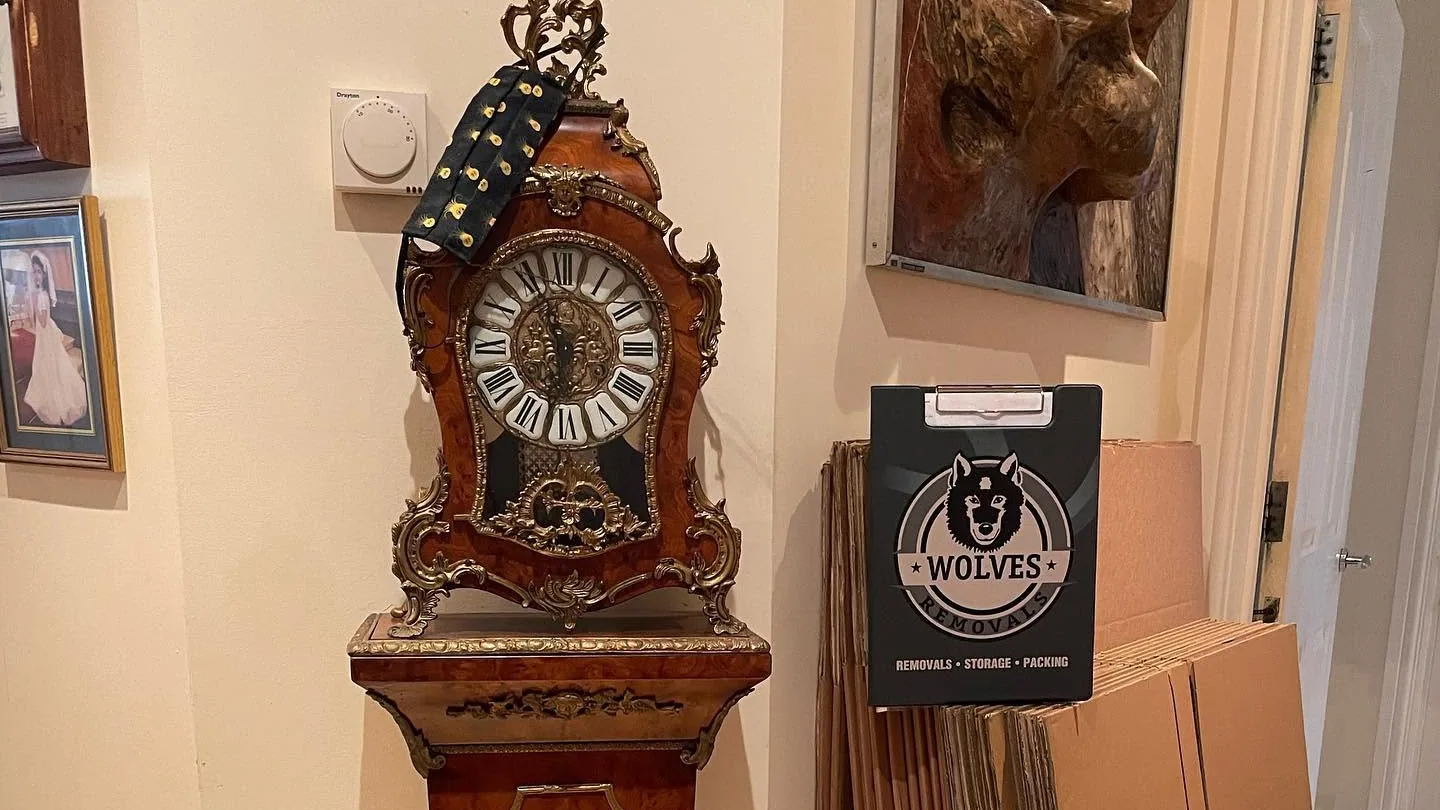
This is where the clock restorers' habits are worth copying, because they pack clocks far more often than most movers do.
- Pendulum. Wrapped, then laid flat and taped to the backboard inside the case with card either side of it, or boxed on its own. Never loose.
- Weights. One towel per weight, wrapped individually, carried separately. Several kilos of lead rolling against a case will go through the panel.
- Chime rods. If the clock has them, push a foam or polystyrene cup onto the ends. Chime rods are long, thin and tuned, and they do not like bouncing.
- Loose parts. Finials, side doors, glass, the winding key, the crank. Bag them, label the bag and put the bag inside the case so it cannot be separated from the clock.
- Doors. Taped shut, with low-tack tape on the finish rather than across it, so the hood door and trunk door cannot swing on the move.
Moving the Case
Empty, a longcase clock is not especially heavy, but it is tall — commonly up to around eight feet — narrow and top-heavy, with most of its value in a fragile hood at the highest point. It is a two-person lift for balance, not weight.
It travels upright, strapped top and bottom, with the strapping bearing on the case rather than the mouldings. Plan the route before anything is lifted: a clock that has stood in one corner for decades has usually never been round the turn at the top of the stairs, and what catches people out is the diagonal on a half landing, not the doorway.
Setting It Back Up: Level First, Then Beat
This is the half of the job that almost no guide covers, and it is why clocks stop after a move rather than during one.
Put the case where it is going to live and level it before anything else. A spirit level across the front edge of the base, just above the feet, checked in both directions, with thin packers under the front corners until the bubble sits centre. Do this first, because the beat you set next depends on gravity: a clock set up perfectly on a tilt goes out of beat the moment it is straightened.
Two things people forget at this stage:
- The skirting board. A case pushed flat against the skirting leans forward at the top, and the pendulum can catch the backboard. A thin block behind the base sets it upright again.
- Fixing it to the wall. Most longcase clocks have existing holes in the backboard for exactly this. Two screws into the wall is the difference between an heirloom and an accident, and it matters more than usual with children, dogs or a floor that flexes.
Then rebuild in reverse, in this order:
- Movement onto the cheeks, pulleys hanging free.
- Hood back on its rails.
- Pendulum threaded up through the crutch loop and onto the back cock, so its own weight settles the movement onto the seat.
- Suspension block checked centrally in the crutch loop, before you hang a single weight.

Getting the Clock Back In Beat
Start the pendulum and then stop talking and listen. You are after an even tick…tock…tick…tock, as regular as a dripping tap. What you do not want is tick…tock-tick…tock, with the gaps uneven.
That is a clock out of beat, and it will swing for a few minutes and then stop, which is exactly the complaint people report the day after a move. Wolves Removals
If the case is level and the tick is still uneven, the crutch needs adjusting. The rule is counter-intuitive but reliable, and it is the one longcase dealers give: if the longest gap falls when the bob swings right, bend the crutch left; if the longest gap falls when it swings left, bend the crutch right. Small movements, one at a time, listening after each. Some later movements are self-adjusting and will find their own beat if you simply let them run.
If you cannot get an even tick after a few careful attempts, stop — a bent crutch is an expensive thing to get wrong.
Setting the Time and the Strike
Move the minute hand clockwise only, pausing at each hour and half hour to let the clock strike or chime before you carry on. The rule with an antique longcase is simple and absolute: never turn the hands backwards. Forcing a strike train against its own sequence is how levers bend.
If it is a thirty-hour with a count wheel and it is striking the wrong number, it is out of sequence rather than broken. Some have a small lever or wire to advance the strike; otherwise you let it strike its way round until the count and the hands agree again.
Leave it a week before judging its timekeeping, then regulate with the nut under the pendulum bob: right to speed up, left to slow down. Wind with the trunk door open so you can watch the weights travel, easing off as they near the top.
When to Call a Clockmaker Instead
Get a professional in if any of these apply:
- The movement is screwed to old, dry timber.
- The clock is a named maker or has real value.
- It is a bracket or musical movement rather than a plain longcase.
- It has been moved once already and has not run properly since.
A snapped suspension spring or a split case cheek is expensive to put right, so on a clock like this it is worth calling a clockmaker before you start rather than after something breaks.
Grandfather Clock Moving Service in Sussex
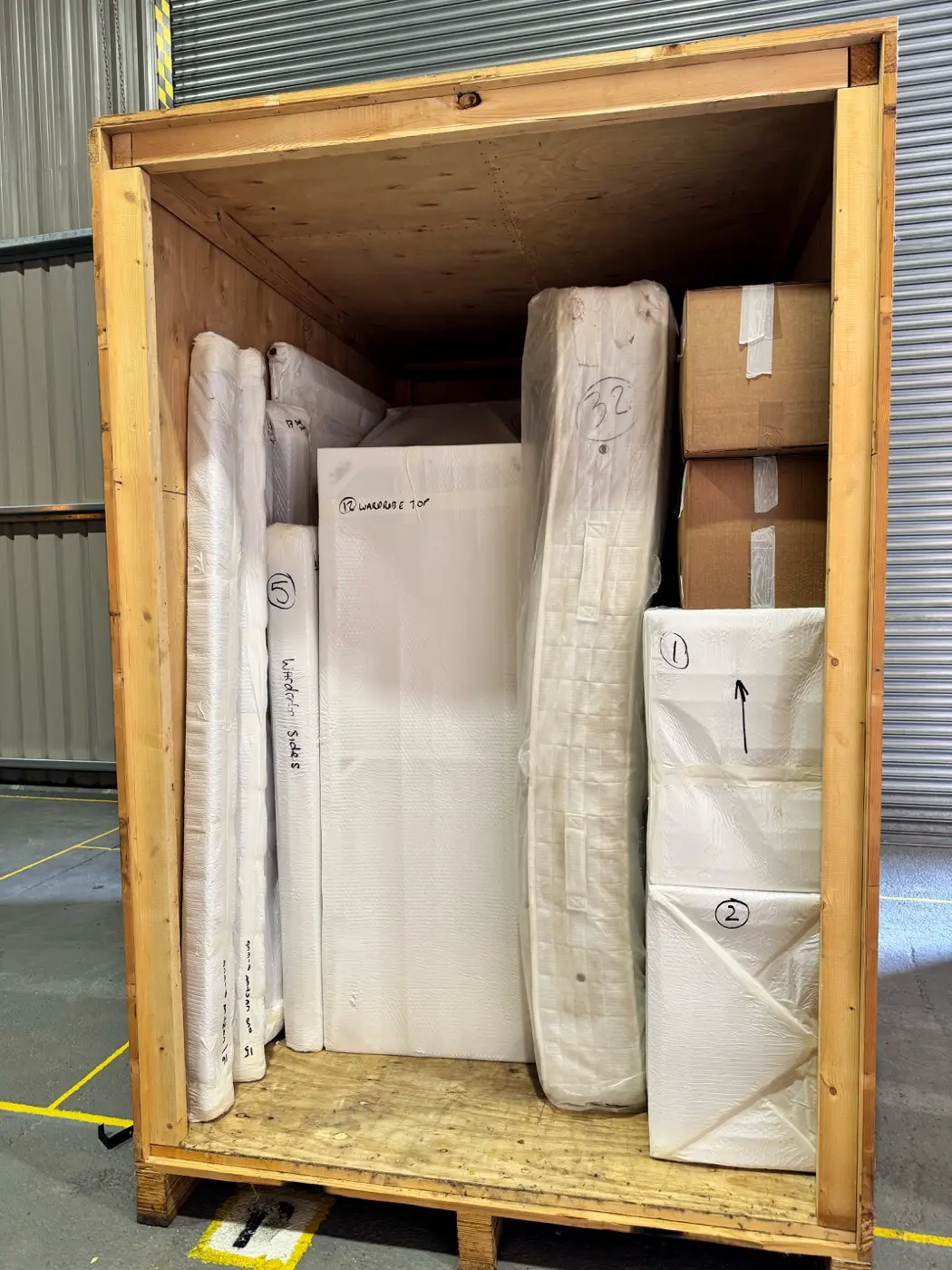
We transport longcase clocks as part of house moves across Sussex and Surrey, and the approach is the one above: it comes apart before it goes in the van, the weights and pendulum travel labelled and packed separately, and the case goes upright and strapped. We are a LAPADA Approved Service Provider, and clocks sit alongside the antiques and fine art we handle most weeks.
What we are not is a clockmaker. On a valuable movement we will happily work alongside one — they dismantle and reinstate, we handle the case and the journey. Mention the clock when you ask for a quote and we will plan it in rather than meet it on the day.
The Wolves Removals Team
Family-run removals · Ashington, West Sussex
We have moved families and businesses across West and East Sussex, Surrey, Hampshire and Kent since 2016, from our Ashington base. We are fully insured, Checkatrade-verified and a LAPADA Approved Service Provider for antiques and fine art. More about us, or read our reviews.
How to Move a Grandfather Clock — FAQs
It is better not to. The safe default is upright and strapped, top and bottom, with the pendulum, weights and ideally the movement already removed. Some professional movers do carry clocks on their backs with foam packed against the door glass, and done properly it works, but laying a clock down loads the case joints and the hood in a direction they were never built for.
Yes, always, even for a short journey. The pendulum hangs from a suspension spring — a thin flat strip of metal — and moving the clock assembled is the most common way that spring gets broken. The weights are several kilos of lead each and will swing into the case or the movement. Remove both, label the weights left, centre and right, and pack them separately.
Nine times out of ten it is out of beat rather than broken. Listen to it: a healthy clock ticks evenly, like a dripping tap. If the gaps are uneven the pendulum is not getting an even push and it will stop within minutes. Level the case first with a spirit level, packing under the front corners, because beat depends on gravity. If the tick is still uneven, the crutch needs a small adjustment.
On a thirty-hour clock with a single weight this is normal, not damage. That type uses a count wheel, which counts its own strikes rather than reading the hands, so interrupting the striking — which dismantling does — puts it out of step. Let it strike its way round, or use the advance lever if one is fitted. Eight-day clocks with rack and snail striking correct themselves.
The case, yes, with two people and a planned route — it is tall, narrow and top-heavy rather than especially heavy. The parts, mostly yes, if you work in order and label everything. Where to stop is the movement: if it is screwed to the case cheeks and the timber is old, those cheeks can split when the screws come out. On a clock of any real value, have a clockmaker take the movement out and put it back.
It should be. These clocks are tall, narrow and top-heavy, and most have existing holes in the backboard intended for exactly this. Two screws into the wall takes a genuine tipping risk out of the room, which matters most in a house with children or dogs, or on a floor that flexes when people walk past.
Give it about a week in its new position before judging whether it runs fast or slow, then adjust with the regulation nut under the pendulum bob — right to speed up, left to slow down. Judging timekeeping in the first day or two usually just means chasing a clock that has not settled.