Money-Saving Tips When Moving House
To save money when moving house, move less, do the straightforward jobs yourself, pay for the ones that carry risk, and give the councils and utilities your moving dates in good time.

We set out the savings in the order we would make them, from the clear-out before the survey to the hidden costs around moving day.
In short
How do you save money when moving house?
Move less, do the plain jobs yourself and pay for the risky ones, in that order, because what you clear decides what the survey measures and the survey sets the quote.
Spend less, in this order
- Move less. Clear out before the survey.
- Plain jobs yourself. Packing the straightforward things and taking furniture apart.
- Pay for risk. Fragile packing and heavy items.
- The right service. Matched to the size of the load.
- Stop the old bills. Council Tax and water, then energy.
How does clearing out before the survey cut the cost?
The survey measures only what is still there; anything cleared first is never quoted or carried. GOV.UK’s guide to selling a home, written for England and Wales, lists the clear-out among the preparations for moving: “don’t forget about the attic or garden shed”. As our pricing FAQ puts it, “every cubic foot you don’t move is space, time and money saved”.
Clearing the loft first
- Loft and shed first. The two places GOV.UK’s guide names.
- Sell or give away. GOV.UK lists both among the ways to get rid of household waste. What sells where is in our downsizing guide.
- Bulky items. Council collections are in our wardrobe guide, Sussex tip rules in our Sussex moving guide.
- Before the survey. Or shown on it as staying behind.
Do you pay tax when you sell your things before a move?
Usually not. HMRC’s own example is clearing out the attic and selling unwanted items online: if none is worth more than £6,000, you’re unlikely to need to tell HMRC or pay tax, however many you sell.
Before you list it
- Bought to resell? You’re probably trading, HMRC says, if you bought goods to sell for a profit, or made them, even as a hobby.
- Sets count together. HMRC’s £6,000 figure also covers the total value of items that form a set, such as matching ornaments.
- Valuables: check first. Selling a valuable piece, such as jewellery, a painting or an antique, can bring Capital Gains Tax on any gain.
Emptying a whole home? Our house clearance service works “by buying the contents rather than charging you to take them away”; it is not a rubbish removal service and does not collect single items.
How do you get rid of rubbish safely before a move?
In England, check anyone you pay to take rubbish before anything is loaded; our wardrobe guide covers the register’s tiers.
Before anything goes on the van
- Ask for the number. In England, an upper-tier waste carrier’s registration number starts CBDU.
- Check the register. On the Environment Agency register, before loading.
- Offers count too. Defra’s code of practice covers a business that approaches you offering to take your waste.
- Note the van. Keep the receipt and a note or photo of the van’s registration. It isn’t required, but it can help show you checked.
In England, a council can give a householder a fixed penalty of up to £600 for failing the household waste duty of care, though Defra’s fixed penalty guidance says minor breaches that don’t lead to the waste being fly-tipped or otherwise wrongly disposed of should not be penalised.
Small electricals under 25cm on their longest side can often go back free to big electrical shops (over 400 m² of electrical sales space), even if you buy nothing; check the shop’s notice first. Taking back an old appliance is in our fridge guide.
Does packing yourself save money?
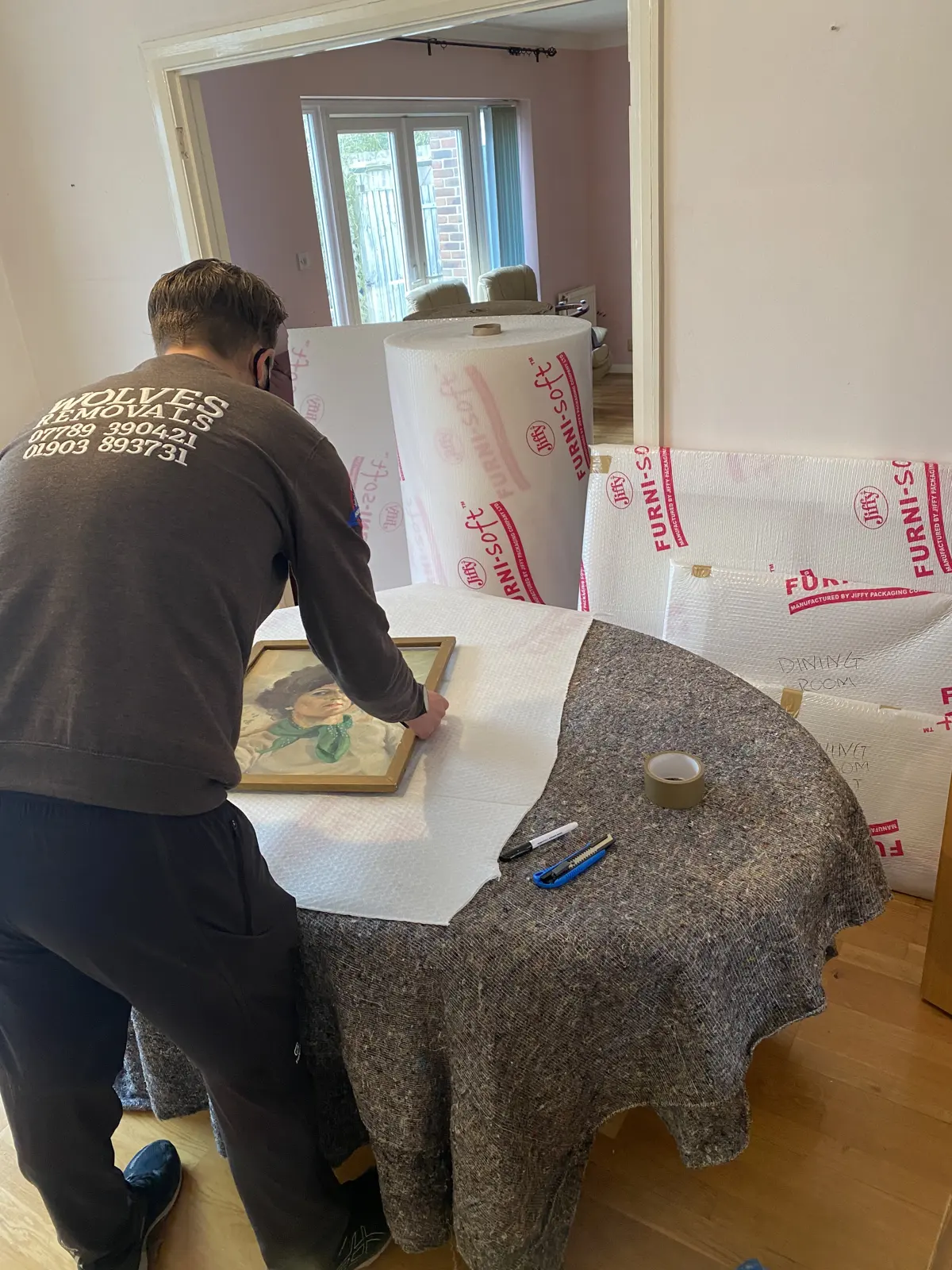
Yes, for the straightforward things; our packing guide sets out who should pack what. GOV.UK’s selling guide notes that having the removal firm pack “will cost extra”, so packing the plain things yourself is a real saving; leave fragile pieces to the crew.
Packing your half
- Plain things yourself. Allow the time: books and linen are among the boxes people underestimate most, our non-fragile packing FAQ warns.
- Fragile to the crew. Worth paying for.
- Packed the day before. GOV.UK’s guide warns that “the morning of moving day is rarely enough time to pack and clean a whole home”.
Second-hand boxes are weighed up in our packing materials FAQ.
From our practice: splitting the packing is “a sensible way to buy a move”, and we offer it “as a standard option rather than a favour”, says our Midhurst to Cheshire story.
Does taking your own furniture apart lower the price?
It can, because the quote then covers less of our time. Our wardrobe guide shows how to take a wardrobe apart.
Jobs you can take on
- Take furniture apart.
- Listed for the quote. Tell the surveyor which pieces you’ll take apart yourself.
- Parking bay. If a street needs a suspension, you apply to the council and pay its fee, and at the survey we say whether either address needs one; our 3-bed guide covers access and parking.
From our crews: on our Haywards Heath to Horsham move, three Luton van loads over two days, “the client took their own furniture apart, so the quote covered the furniture removal only”.
Which days are busiest for moving in West Sussex?
Fridays, by a long way. In West Sussex, about two in five residential sales in 2025 (41.4%) completed on a Friday, by Wolves Removals’ count of HM Land Registry Price Paid Data; the England and Wales picture is in our 3-bed costs guide. These figures count completed sales, not every move, and say nothing about removal prices.
Completion days in West Sussex
- Friday, by far.
- Tuesday, much quieter. 11.0% of the county’s completions in 2025, the quietest weekday by the same count.
- Keys can run late. Ask how waiting time is charged before you book.
Contains HM Land Registry data © Crown copyright and database right 2021. This data is licensed under the Open Government Licence v3.0.
What is worth paying for when you move?
Pay for the jobs where a mistake would cost more than you saved. Our pricing FAQ says leaving fragile packing to the crew “often saves more in avoided breakage than it costs”.
Worth handing to the crew
- Fragile packing. Glass, china and mirrors, wrapped by our fragile packing service.
- Heavy and awkward items. Anything you would have to force; see what to leave to the crew.
- The right-sized crew. Sizing the crew at the survey means “you pay for the right team rather than a flat rate”.
Is a man and van the cheapest way to move house?
For a small load, often, compared with a full removal. For a whole house, the savings are in moving less and doing the plain jobs yourself. If everything fits comfortably in one Luton van with room to spare, our man and van page calls it “almost always the leaner option”. If you’re moving a flat, a few items or as a student, a full removal may be more than you need. Our man and van service starts from £80 + VAT and brings the same care at a lower cost.
When a man and van fits
- Small loads. One piece of furniture, a student room or a few boxes.
- Room to spare. In one Luton van.
- Hourly, depot to depot. Our man and van page says hourly charges apply from depot to depot.
- An honest steer. We’ll give you one at the quote stage.
For more than about a one or two-bedroom flat, depending on access, we usually recommend a full house removal.
How does the survey save you money?
Our fixed quote is built from the survey, so a thorough survey prices in the access and leaves out what you’re not taking; our questions guide lists what any survey should cover. Ours is free, by video or a home visit. On a video survey you walk room to room, open the awkward cupboards and show us the access, as our pricing FAQ describes.
The survey list
- What stays behind. Anything you’re selling, giving away or leaving, so it isn’t measured.
- Cupboards open. Fitted ones included.
- What comes apart. Mention it at the quotation stage so we can plan time for it.
- Access at both ends. Stairs, parking and the walk to the door, at each address.
From our practice: we ask about stairs before quoting “so the stairs are priced in at the quote rather than added on the day”, says our Hove flat move story.
Every quote is fixed, written and itemised, as our pricing page says; the three things that can still change it are in our 3-bed costs guide. How to compare quotes like for like is in our choosing guide.
How do you stop paying Council Tax and water on the old home?
Give each council and your water company your moving date. In England and Wales, Council Tax is worked out day by day, so each bill should stop and start on your moving date, which is why each council needs it. The exception is a home you own that stands empty (see the FAQs).
The old home, closed on the date
- Tell both councils. The old and the new, as our planning guide lists.
- Apply for discounts. They aren’t added for you: GOV.UK says you need to apply, even if you qualify.
- Backdated discount. If a move leaves one adult at home, Citizens Advice’s Council Tax discount guide says the single-person discount runs from the day the other person moved out, even if the council is told later (advice for England).
- Ask for refunds. Paid ahead on the home you’ve left and no refund has come? GOV.UK says to contact that council.
- Water: give notice. If the home has a water meter, tell the water company at least five working days before you leave, or you may be charged beyond your move-out date, says the Consumer Council for Water, which covers England and Wales.
What energy charges catch people out after a move?
At the new home you’re automatically on the current supplier’s standard or default tariff until you choose, and Citizens Advice says you can switch only from the day the home becomes your responsibility (its advice is for England).
Energy at both ends
- Fixed deal? Ask. Citizens Advice says your supplier might let you keep the same tariff at the new home without charging a fee.
- Call before topping up. If the new home has a prepayment meter, contact the supplier first; otherwise, Citizens Advice warns, you risk paying extra for debts left by the people before you.
- Final bill and credit. Citizens Advice says your old supplier should send the final bill within 6 weeks and refund any credit within 10 working days of sending it.
- Old bills, limited. Under Ofgem’s back-billing rules, which cover Great Britain, you don’t have to pay for energy used more than 12 months ago that you were never correctly billed for. The exception is if you acted unreasonably, for example by blocking access to the meter.
Meter readings and the notice to give are in our last-minute moving guide.
About this guide. Sources, read 16 November 2026: legislation.gov.uk, GOV.UK (including HMRC, Defra and HM Land Registry), the Environment Agency, Citizens Advice, Ofgem and the Consumer Council for Water. Where a rule covers only England, England and Wales or Great Britain, the text says so. General information, not financial advice.
Your next steps
- Book a free survey.
- Size your home with the removals calculator.
- Read how we price a move.
Jack Wolfe
Director, Wolves Removals · Ashington, West Sussex
Jack runs Wolves Removals, which has moved families and businesses across West and East Sussex, Surrey, Hampshire and Kent since 2016 from its Ashington base. The firm is fully insured, Checkatrade-verified and a LAPADA Approved Service Provider for antiques and fine art. More about us, or read our reviews.
Money-Saving Tips When Moving House — FAQs
For smaller loads, yes. Our man and van service starts from £80 + VAT and suits flats, students and single items.
Build it from your own quotes, not an average, and allow for money that arrives late. Our guide to 3-bed house removal costs shows what real removals cost, and our guide to what to consider when moving lists the costs beyond the van. If you rent in England or Wales and your deposit is in a government-approved protection scheme, GOV.UK says your landlord must return it within 10 days of you both agreeing how much you’ll get back.
Usually, in England and Wales, if you still own the old home and it stands empty. GOV.UK says you’ll usually have to pay Council Tax on an empty home, but your council can decide to give you a discount, and the amount is up to that council.
Usually the ones around the move itself: a parking suspension fee if a street needs one, storage and a second move if the dates don’t meet, and bills left running on the old home. Ask before you book how waiting time is charged if the keys are late.