How to Pack a Picture for House Removals: A Step-by-Step Guide
How to pack a picture, mirror or framed print for a move: taking it down, carrying, taping the glass, wrapping, boxing, the van, storage and unpacking.

To pack a picture or other framed artwork for a move, take it down with two people, cover the face with acid-free tissue, pad the corners, wrap it in bubble wrap with the bubbles facing out, and stand it on its edge in a box sized to the frame. If you tape the glass, cover the whole pane, never just a cross, and never tape acrylic. For a valuable, old or gilt-framed piece, see when to hand it over.
The quick answer
Carrying: Two people, one hand under, one at the side
Taping glass: Whole pane or none, never a single cross
Wrapping: Tissue on the paint, then bubble wrap, never straight onto paint
In the box: On its edge, with card between each picture
What You Need to Pack a Picture
To pack a picture or other framed artwork, you need low-tack tape, acid-free tissue, corner protectors, bubble wrap, a picture carton or stiff card, and packing tape and a marker.
Picture packing materials, roughly in order of use
Low-tack tape: only if you are taping the glass
Acid-free tissue or glassine: for the face of a painting and round a gilded frame
Corner protectors: or folded card, one on each corner
Bubble wrap: over the tissue
A picture carton: or two sheets of stiff card cut larger than the frame
Packing tape and a marker: for the wrap and the label
Sources: Museums Galleries Scotland and the US National Park Service.
Our box shop sells bubble wrap and tape; our fragile packing service uses telescopic picture cartons, flat boxes that adjust to the frame.
How to Take a Picture Off the Wall
Before taking a picture off the wall, check the hook, the wire and the frame, then lift it with two people.
Taking a picture down: three checks, then the lift
-
Look at the hook and wire. Rusty or loose fittings can let go, and hooks can pierce a neighbouring canvas, so take them off or pad them.
-
Check the frame for loose ornament, open corners or a loose fixing, and deal with them first.
-
Look for old damage or repairs and photograph them, so its condition is on record. Keep any old labels on the back; they can record its history.
-
Know where it will be set down, on padding, not the bare floor, before two of you lift it.
Sources: the Canadian Conservation Institute, the US National Park Service (paintings, handling) and Museums Galleries Scotland.
How to Carry a Picture
Carry a picture to where you’ll pack it with two people, one picture at a time. The Canadian Conservation Institute says even an ordinary-sized painting is a two-person carry, and most paintings need a spotter as well.
Carrying a picture: who holds what
-
One hand under the bottom edge.
-
The other hand on the side. Never carry it by the wire or the top of the frame.
-
A spotter watches the doorways and walls, and you agree each move before you make it.
-
Where a backing board is fitted, carry a painting face towards you, so the board takes any knock.
Sources: the Canadian Conservation Institute and Museums Galleries Scotland.
Should You Tape the Glass on a Picture or Mirror?
Taping the glass on a picture or mirror before wrapping and boxing is optional. If you tape it, cover the whole pane, and never tape acrylic. Where museums tape glass, they use slightly overlapping strips of low-tack tape, or a close grid, so most of the shards are held away from the picture if it breaks.
Glass, acrylic and the cross
-
Glass: if you tape it, cover the whole pane with low-tack tape, in overlapping strips or a close grid, and take it off as soon as possible after the move.
-
Acrylic (plastic) glazing: leave it bare. The US conservators’ wiki says the adhesive can’t be removed.
-
Not a single cross. No conservation source we checked advises it.
-
Tape the glass only, never the frame, and don’t leave ordinary tape on coated or anti-reflective glass.
Sources: the Canadian Conservation Institute and the American Institute for Conservation wiki.
The sources don’t all agree. A US National Park Service leaflet tapes acrylic too, and in tests reported by the Canadian Conservation Institute, damage was often similar whether or not the glass was taped. If you can’t tell glass from acrylic, leave the tape off.
On our fragile packing service we tape a protective grid across the glass face of mirrors and glazed pictures.
How to Wrap a Picture Frame
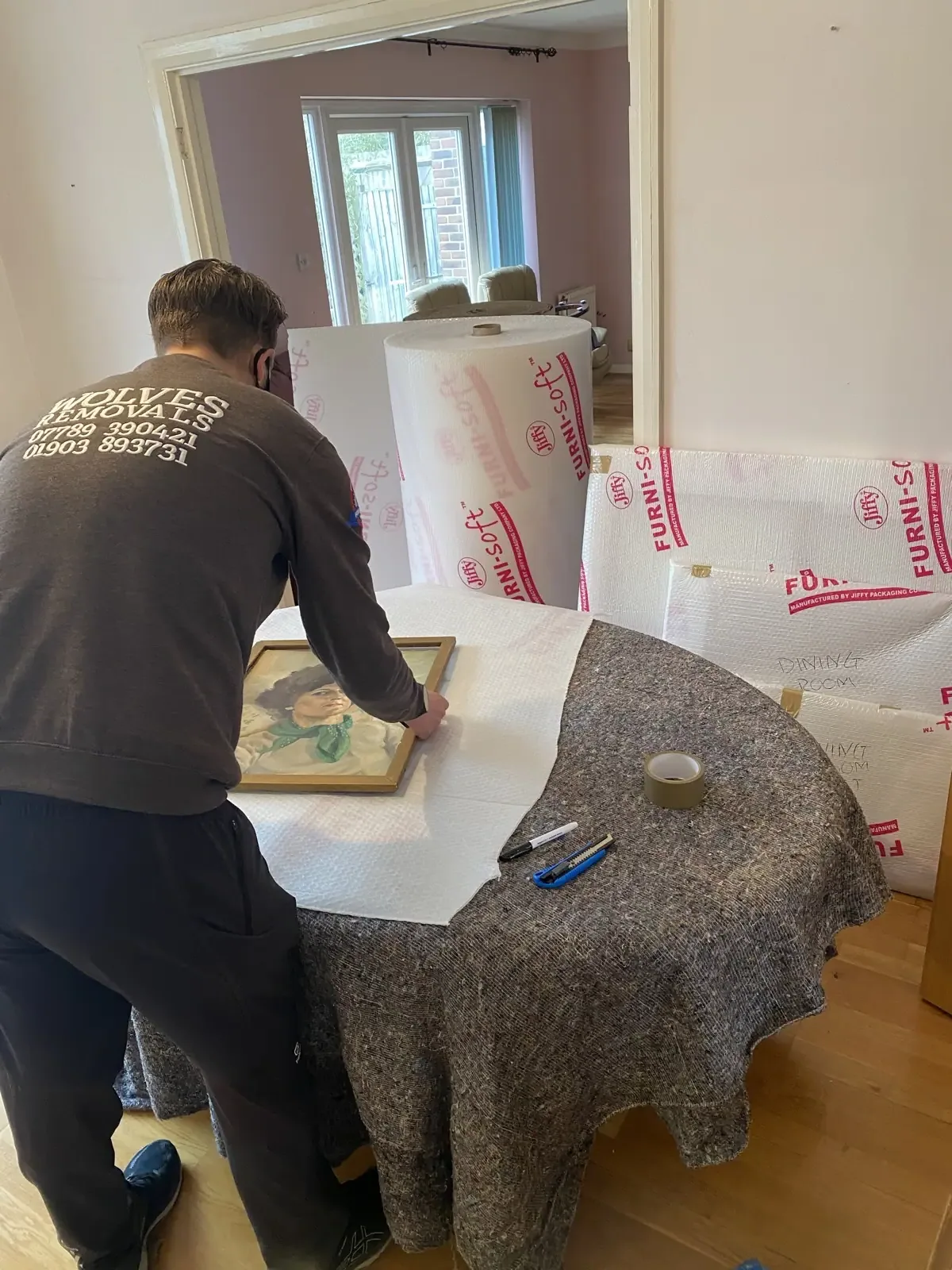
To wrap a picture frame, lay tissue on the face, pad the corners, add bubble wrap with the bubbles facing out, and tape only the wrapping.
Wrapping framed artwork: tissue, corners, bubble wrap, then card
-
Acid-free tissue or glassine over the face, and round a gilded frame. Bubble wrap never goes straight onto paint.
-
A protector on each corner. Corners take the knocks.
-
Bubble wrap, bubbles facing out, because bubbles can mark a surface.
-
Tape the wrapping to itself; nothing sticky touches the gilding or the paint.
-
No picture carton? Sandwich it between two sheets of stiff card cut larger than the frame.
Sources: Museums Galleries Scotland and the US National Park Service.
How to Pack Picture Frames in a Box
To pack picture and photo frames for moving, stand each one on its edge in a box sized to it, with card between frames and nothing able to move.
Two ways in, one to avoid
-
One picture: a carton sized to the frame, with the gaps filled so it can’t move.
-
Several small or medium pictures, or photo frames: on their edge in an ordinary box, a sheet of card between each.
-
Never flat in a pile. Unframed prints are the exception (see below).
-
For small, fragile framed pieces, museums often double-box: a padded box inside a larger padded box.
Sources: the US National Park Service and the Canadian Conservation Institute.
On our full packing service we immobilise each piece within its carton and use purpose-made picture boxes for framed and glazed works.
How to Label a Picture Box
Mark a picture box FRAGILE, GLASS and THIS WAY UP, and never write what it’s worth on the outside.
What goes on the box
-
FRAGILE.
-
GLASS, if there is glass inside.
-
THIS WAY UP, with arrows on the sides.
-
Not “artwork” or “valuable”.
-
Label the wrapped picture itself on both faces, on the wrapping, never on the back of a canvas.
Sources: the US National Park Service and Museums Galleries Scotland.
How to Pack Canvases, Prints and Photo Frames
Framed pictures behind glass travel on their edge, a canvas needs nothing touching its paint, and unframed prints travel flat in folders.
What’s in the frame changes the packing
Framed, behind glass
-
Glass or acrylic must never touch the paint; a spacer in the frame keeps a gap
-
Travels upright on its edge, with padding between each one
Canvas, no glass
-
Tissue over the paint first; nothing presses on the surface
-
An unframed canvas can go in a shallow box deeper than the canvas, with a card lid, so nothing rests on the paint
Prints and drawings, unframed
-
Flat, in acid-free folders inside a rigid box
-
No sticky tape on them, even to hold a wrap closed
Photographs and photo frames
-
Hold them by the edges; never touch the picture side
-
Glazed photo frames are safest upright; large or brittle-mounted prints are better flat
Sources: the Canadian Conservation Institute, the US National Park Service, Icon and the Library of Congress.
Pastel and charcoal can rub or shake off, so conservation guidance advises against moving them where possible. For a valuable one, ask a conservator first.
How to Pack a Mirror or a Large Picture
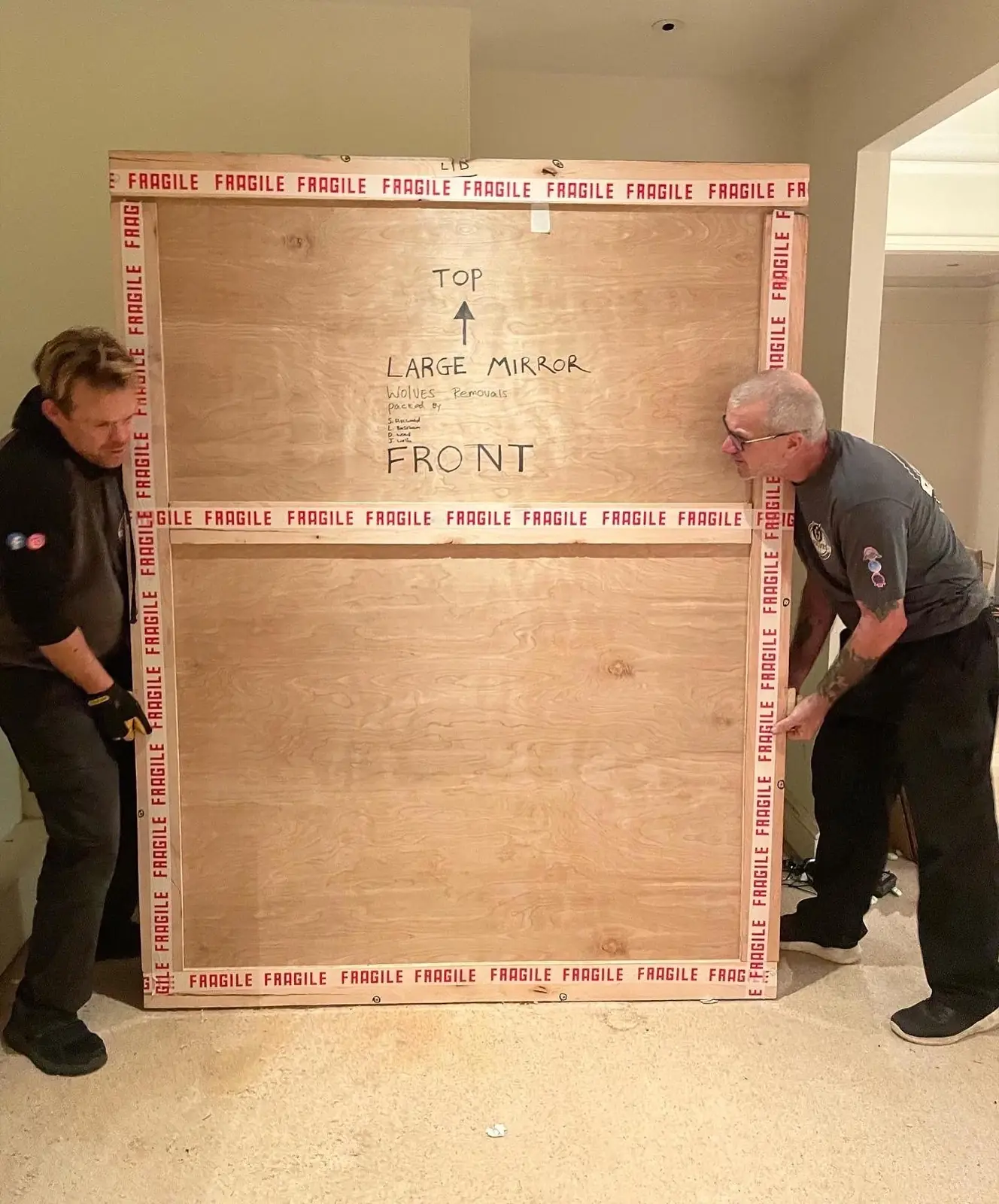
A mirror packs like a glazed picture, then goes into a carton or a crate and travels on its edge. Carry it upright, to spread its weight and reduce the chance of cracking, and get help if it is heavy (US National Park Service).
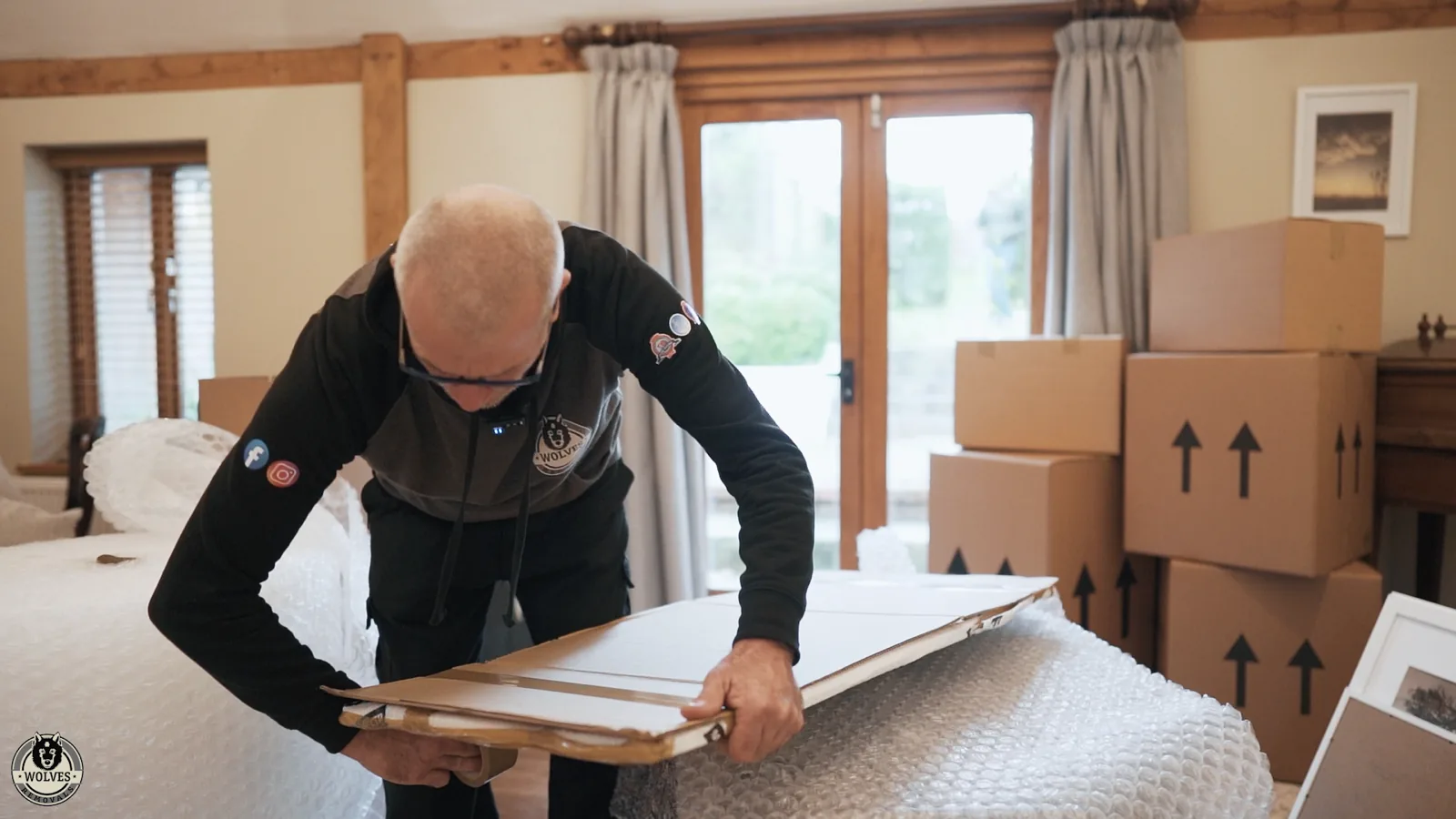
How our video packs a mirror
-
Laid face down on padded wrap.
-
The wrap folded over and taped to itself, like a parcel.
-
A flat carton folded round it and taped along its length.
-
The carton labelled.
A picture too big for any carton goes between two sheets of stiff card, or into a crate; our guide to when antiques need a crate covers mirror boxes, triple-wall cases and timber crates. Mirrored wardrobe doors travel like a mirror, as our guide to moving a wardrobe explains.
Old mirrors
-
A mirror made before the early 20th century may be a tin-mercury mirror: bluish, less reflective, sometimes with mercury droplets at the bottom of the frame.
-
Keep it upright, the way it hangs. Laying a mercury mirror flat can speed up its decay, so unlike the mirror in our video, don’t lay one face down to wrap it.
-
Handle a possible mercury mirror in disposable gloves, and ask a conservator to look at an unstable one before it moves.
Sources: the American Institute for Conservation wiki and the US National Park Service.
How Pictures Travel in the Van
In our vans, pictures travel upright, against something firm, and unable to move.
How we load them
-
Each picture in a carton sized to the frame.
-
Upright on its edge, never laid flat where the centre of the glass can flex.
-
Against a firm surface.
-
Wedged so it can’t slide, loaded last, never under heavier furniture.
From our fragile packing service page.
Cold matters too. The Canadian Conservation Institute says paintings shouldn’t travel in an unheated vehicle in cold weather; acrylic paintings are the most sensitive.
How to Pack Pictures for Storage
To pack pictures for storage, keep them on their edge, off the floor, and somewhere dry and steady.
Where pictures wait
-
On their edge.
-
On padded blocks at least 7 to 10 cm off the floor.
-
With card between each; leaning them against a wall is short-term only.
-
Not in the loft or the cellar: lofts get very hot and dry, cellars damp. Keep them away from outside walls and radiators too.
-
Bubble wrap is for the journey. Left against a surface for a long time it can leave marks.
Sources: the Canadian Conservation Institute (storage, packaging materials) and the US National Park Service.
Our storage warehouse is dry, ventilated and managed, and in long-term storage anything genuinely delicate is crated or padded.
How to Unpack a Picture After the Move
Let the picture warm up in its wrapping, unwrap it on padding, and check it before anything else.
Four steps at the other end
-
Let it warm up. Off a cold van, leave it wrapped until it reaches room temperature, or moisture can condense on it; the Canadian Conservation Institute says most museum packaging takes 12 to 24 hours.
-
Open out every piece of wrapping before it goes away, in case a fragment or a fitting is inside.
-
Peel any tape low and flat along the glass from a folded tab. Pulling it straight up strains the glass.
-
Photograph any damage straight away, before anything else is moved.
Sources: the Canadian Conservation Institute, the US National Park Service and the American Institute for Conservation wiki.
When to Use Professional Packing or a Crate
Pack it yourself if it’s an ordinary print or a modern frame. Hand it over if it’s valuable, old, gilt-framed or too big for a carton. Wolves Removals is a LAPADA Approved Service Provider, and our specialised antiques moving service covers oil paintings, gilt frames and gilt mirrors.
Which service does what
Fragile packing: just the china, glassware and artwork
Full packing: the whole house, pictures included
Custom crate: made to measure for one piece, priced individually by size and intricacy
Antiques moving: every piece condition-checked before it is wrapped
From our fragile packing, full packing, custom crate and specialised antiques service pages.
For one piece that needs more than a carton, our custom crate service builds it a case.
Tell your remover about any valuable pictures before the move. Which? notes that cover can be limited per item or per box unless the value is declared.
Moving pictures or mirrors?
Tell us about them at a free survey, and we’ll plan the packing, and a crate where one is worth building.
The Wolves Removals Team
Family-run removals · Ashington, West Sussex
We have moved families and businesses across West and East Sussex, Surrey, Hampshire and Kent since 2016, from our Ashington base. We are fully insured, Checkatrade-verified and a LAPADA Approved Service Provider for antiques and fine art. More about us, or read our reviews.
Frequently Asked Questions
It’s optional. If you tape it, cover the whole pane with overlapping strips of low-tack tape or a close grid, not a single cross, and take it off soon after the move. Never tape acrylic glazing or the frame.
Upright, on their edge, with a sheet of card between each picture. Never lay framed pictures flat in a pile. The exception is unframed prints and drawings, which travel flat in acid-free folders inside a rigid box.
Cover the paint with acid-free tissue or glassine first, then bubble wrap, bubbles facing out. Nothing should press on the paint. An unframed canvas can travel in a shallow box deeper than the canvas, with a card lid.
Pad the corners, protect the face, wrap it, and box or crate it. Then carry and load it on its edge, with help if it is heavy. An old mirror may be a tin-mercury mirror: keep it upright and handle it in disposable gloves.
Yes. On our fragile packing service each piece is wrapped, corner-protected and slotted into a telescopic picture carton sized to the frame. A valuable piece can have a made-to-measure crate, priced individually by size and intricacy.