The Oxygen Chamber on the Thirty-Seventh Floor
Some jobs are hard because of what you are moving; this one was hard because of where it was.

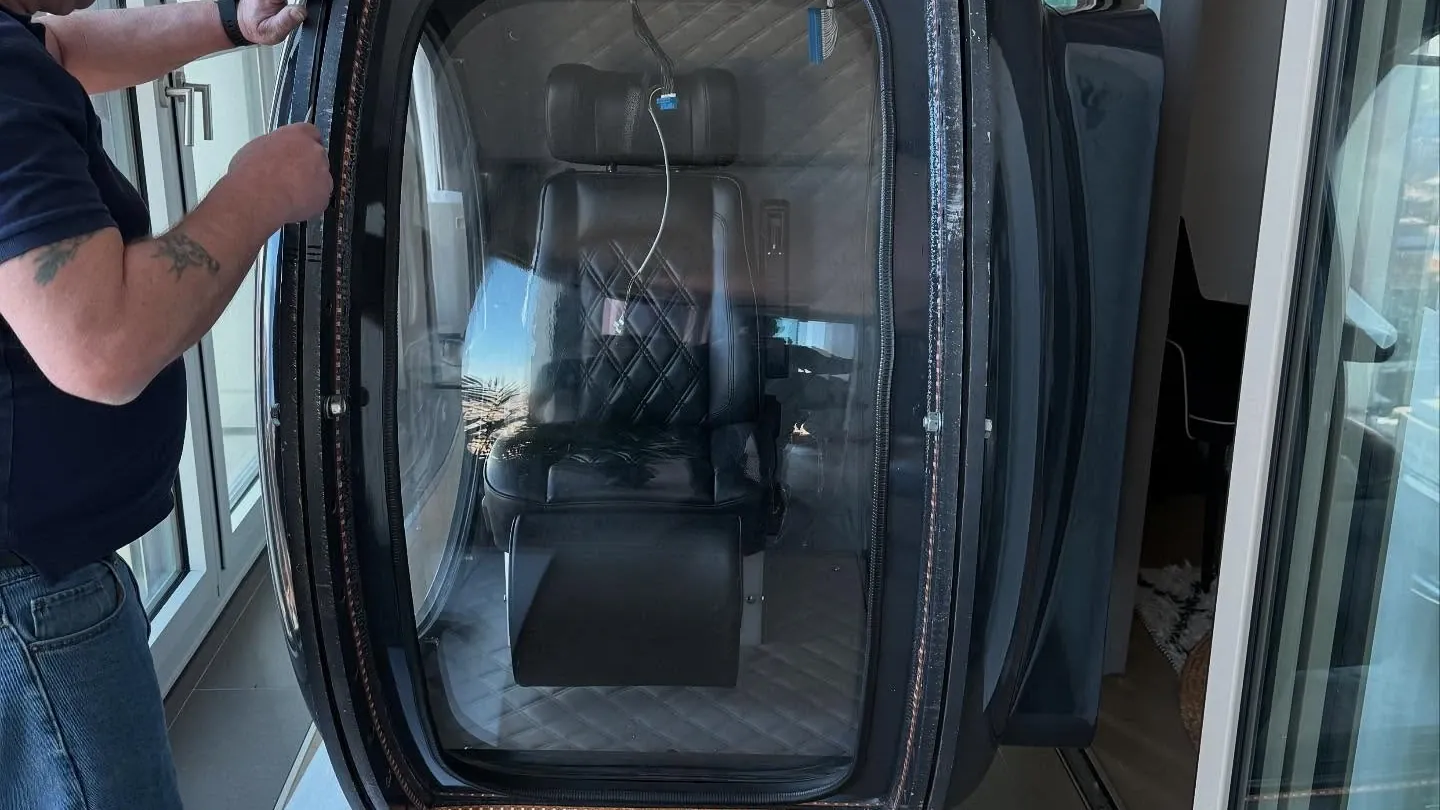
Wolves Removals faced a hyperbaric oxygen chamber, a private apartment thirty-seven floors up in central London, a passenger lift built for people and shopping, and a street outside with nowhere legal to stop.
The Object Was the Easy Part
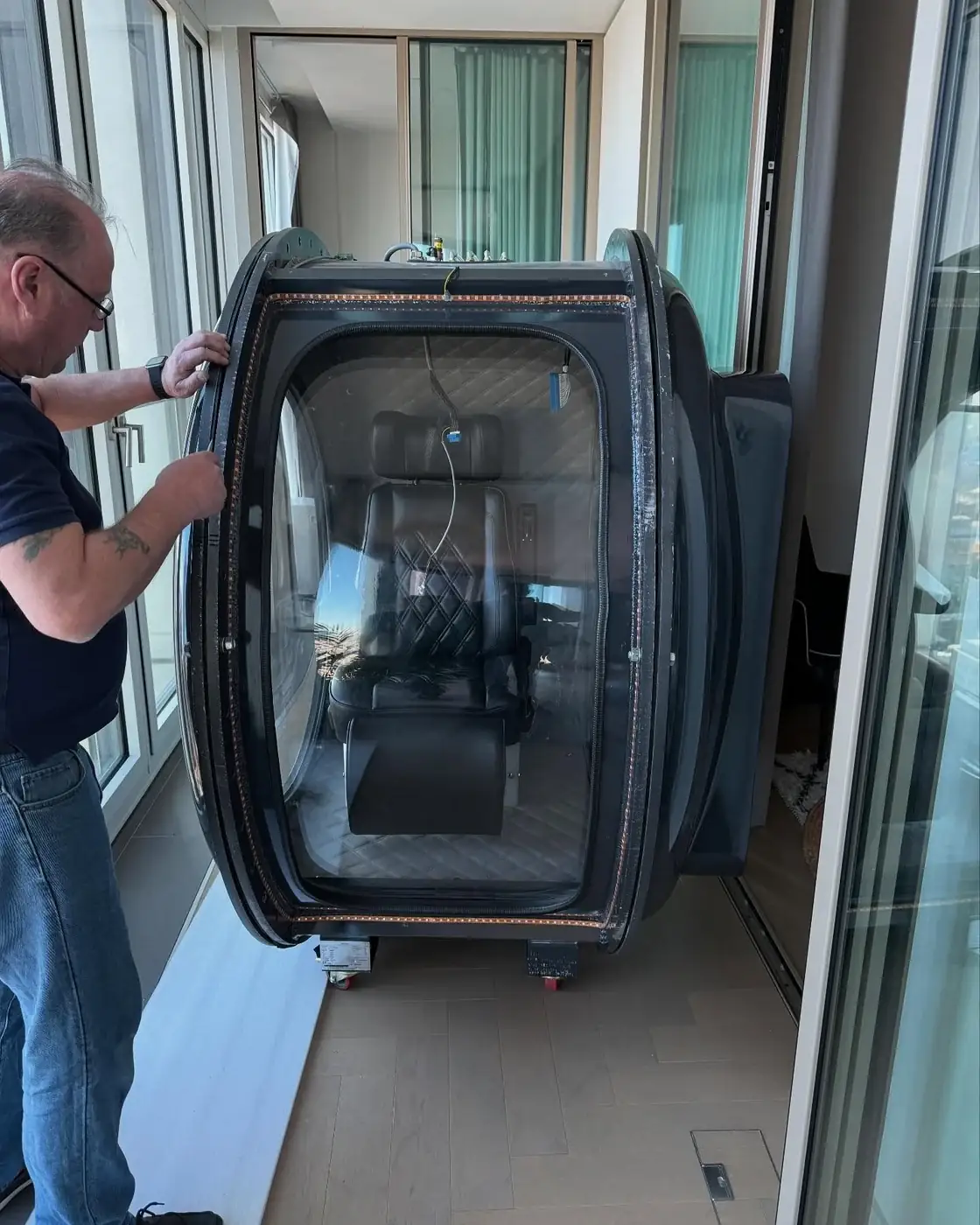
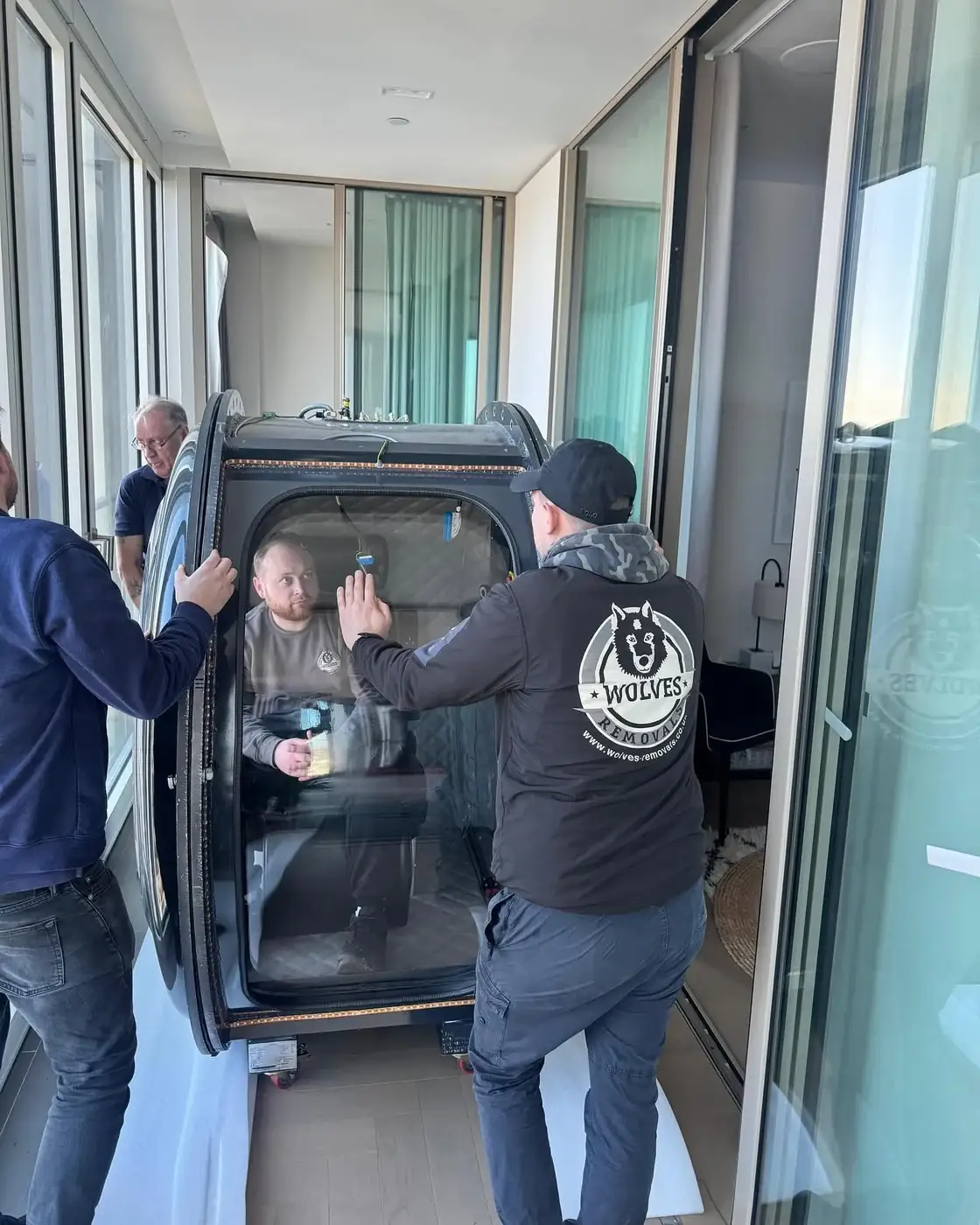
A hyperbaric oxygen chamber is not a thing most removal crews will see twice. This one was a rigid seated pod: a steel and acrylic shell about the height of a person standing, a single reclining seat inside, a control manifold on the top, and a large curved section at each end that unbolts. It sits on castors, which sounds helpful and mostly is not, because castors are for moving something across one flat floor, not for taking it out of a building.
To be clear about what we did and did not do: we moved it. We did not service it, commission it, install it or test it. Specialist equipment gets disconnected and signed off by the people qualified to do that, and then it becomes a very awkward object that has to get from a room to a lorry. That second part is ours.
Three things make an object like this awkward, and weight is not really one of them. The first is the acrylic. Large curved panels do not fail by being dropped so much as by being leaned on, twisted or set down on a single hard point, and a scratch across a viewing panel is not a scuff you polish out. The second is the manifold on top: valves and fittings that stand proud of the shell, are the first thing to meet a door frame, and are the last thing you want to take the load. The third is that the shape gives you almost nowhere honest to hold. A wardrobe has edges. A pod is a smooth curve, and a smooth curve wants to rotate in your hands.
So Wolves Removals builds the handling plan mostly around where people stand. Every piece gets more hands than it strictly needs, one person does nothing but watch the gap between the load and the building, and nothing is set down anywhere that has not been covered first.
Why It Came Apart
Everything about this job is decided by one measurement, and it is not the chamber. It is the lift.
A residential tower has passenger lifts. They are sized for people, shopping and the occasional sofa. For the order of size: the accessibility guidance for new non-domestic buildings puts the minimum passenger lift car at 1100mm wide by 1400mm deep, and even the larger size it describes — the one meant to take a wheelchair plus several other passengers — is only 2000mm by 1400mm. Flats sit under a different volume, so treat that as a yardstick rather than the rule here. Either way, none of it is a size designed around removals. A sealed pressure pod does not go into a lift like that standing up and assembled, and you do not find that out on the day. You find it out at the survey, which is the entire reason a survey exists.
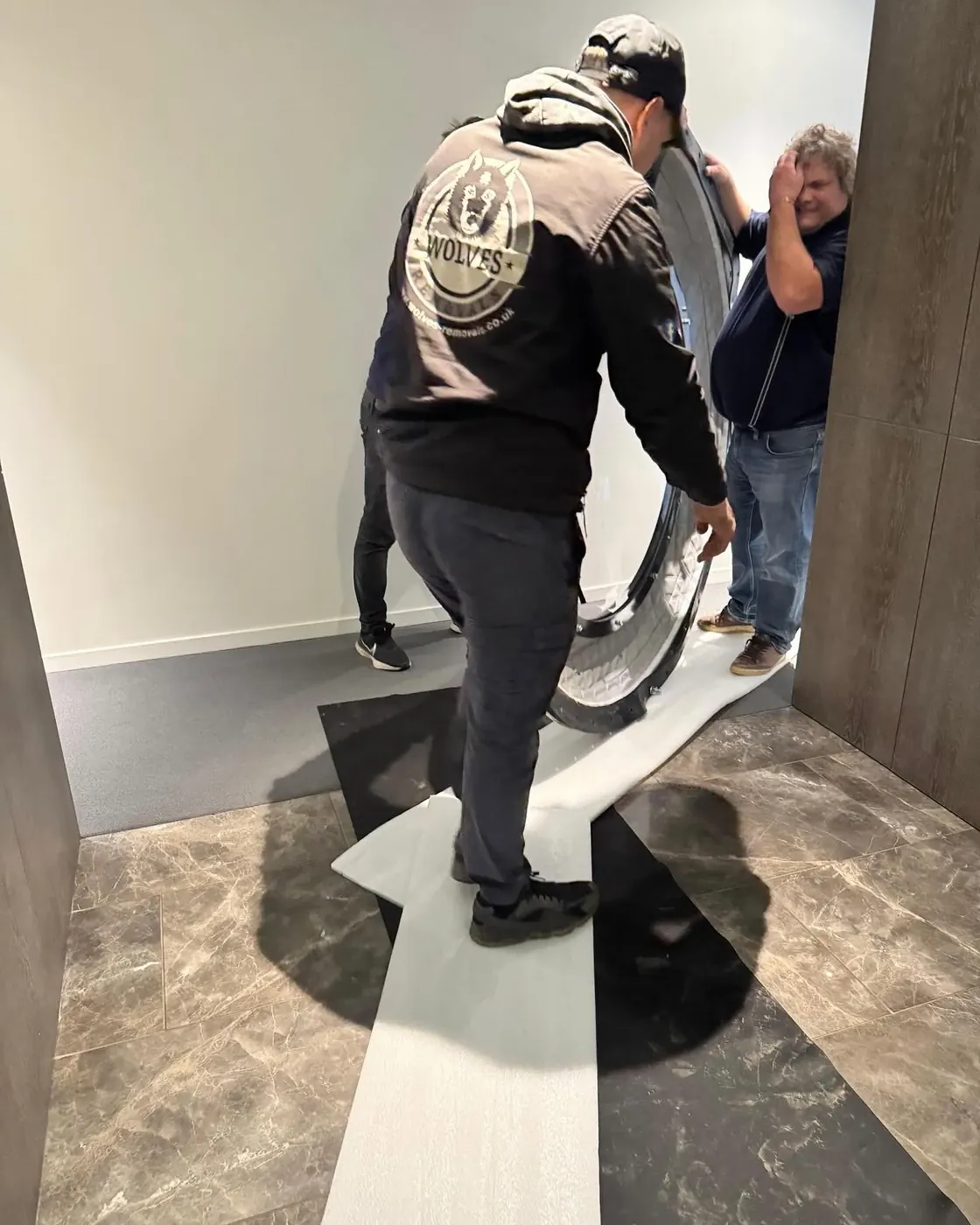
So it came apart. The curved section at each end unbolted and travelled as its own item, edge-on, which is how you get a large disc through a normal doorway. The body went on skates with its castors locked. Each piece was a separate carry, a separate lift trip and a separate thing to protect.
Thirty-Seven Floors of Somebody Else’s Building
Here is the part people underestimate. On the 37th floor of a residential tower you are not just moving your client’s property. You are moving it through a building that belongs to several hundred other households, past their front doors, across their stone lobby, in their lift. Every scuff is somebody’s service charge.
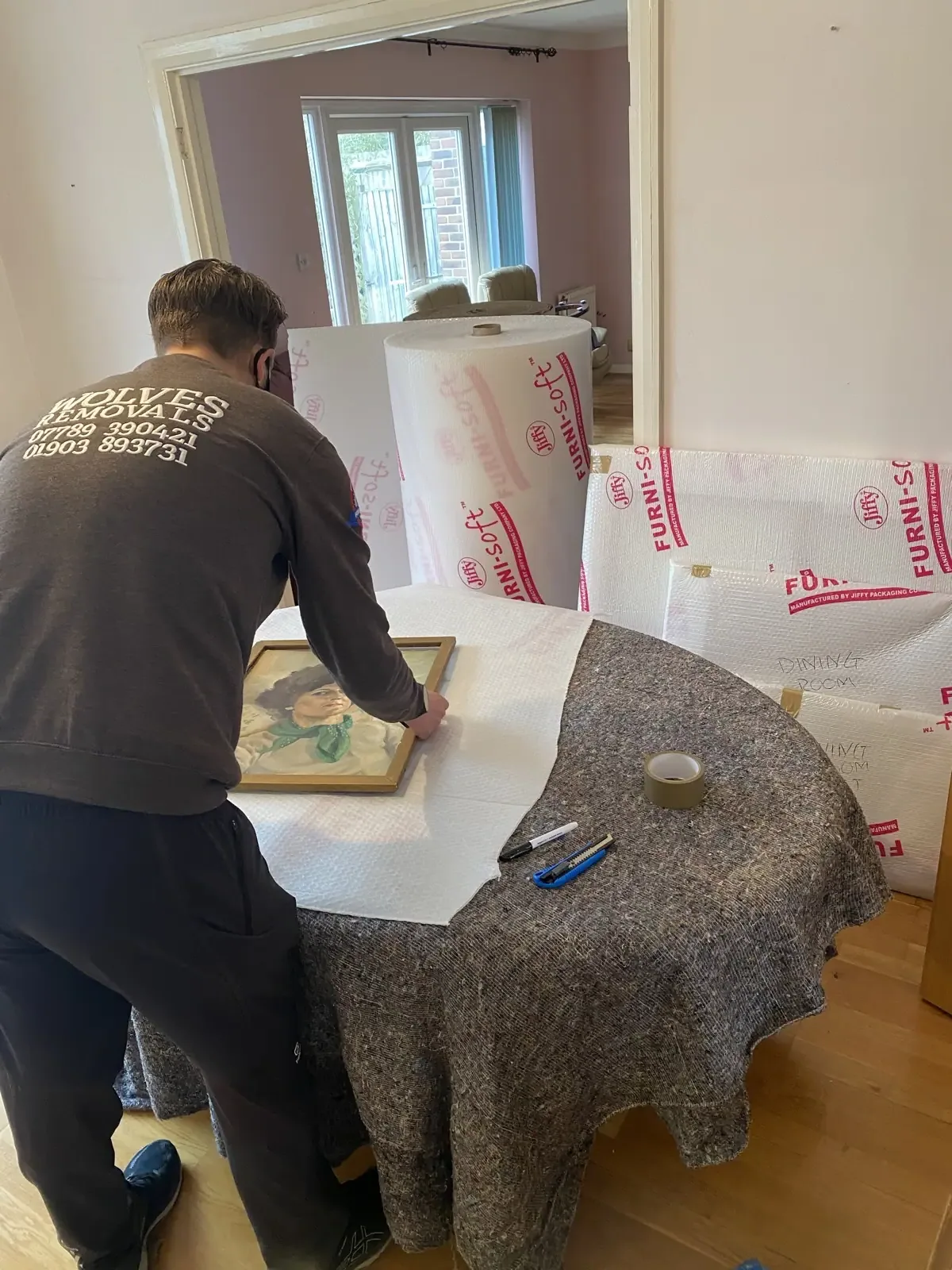
That is why the floor protection in these photographs is not decoration. It runs from the flat door to the lift, and from the lift to the street door, and it goes down before the first piece is lifted. On a job like this the covering takes longer to lay than the chamber takes to come apart, and it is the cheapest thing in the whole day.
The Street Was Harder Than the Tower
Central London does not really do loading. The street here is narrow, granite-paved, double yellow the length of it, with no bay and nowhere to pull in. The lorry stops where it can stop, and from that moment the clock is a real thing rather than a figure of speech.
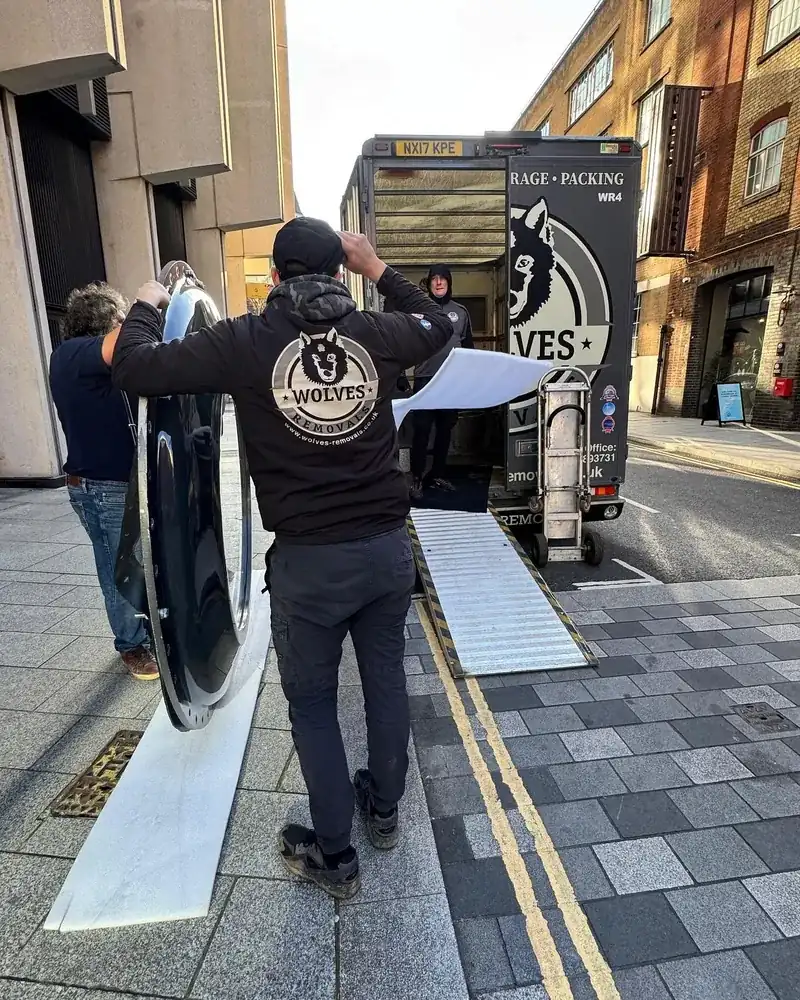
The rule people get wrong is the yellow lines. Double yellows prohibit waiting at any time, but the Highway Code is explicit that loading and unloading “may be permitted where parking is otherwise restricted” — what stops you is yellow markings on the kerb with a sign saying so, and on a red route only a marked bay will do. So the survey question is never “can we park?” It is: what is painted on that kerb, what does the sign say, how long will the load realistically take, and is anybody going to need to get past us while we do it.
The other half is the building’s own rules, which are usually stricter than the council’s. Towers run booked lift slots, out-of-hours windows and a concierge who needs notice. None of that is difficult. All of it is impossible to sort out at eight in the morning with a lorry on double yellows and a chamber still upstairs.
What makes the day survivable is sequencing. Pieces come down in the order they will be loaded, so nothing waits on the pavement and nothing has to be shuffled inside the lorry. The ramp goes down once. Everything that comes out of the building goes straight up it and is secured before the next piece appears at the door.
What “White Glove” Is Actually For
It is a phrase that gets used loosely, so here is the working version. A white glove move is one where the object is unusual enough that the plan has to be built around it rather than the other way round — where somebody surveys it, decides how it comes apart, works out what it fits through, and only then books a date. The opposite is turning up with a van and a hope.
Most of what we move is houses. But the same discipline covers the things that do not fit the pattern — pianos, antiques and fine art, machinery, and whatever is behind the door on the 37th floor. If it needs a crate built around it, we build one.
The chamber went down thirty-seven floors, across a lobby, over a pavement and into the lorry without a mark on it or on the building. Nobody photographed the bit where four people stood in a lift with a curved acrylic panel and said nothing for ninety seconds. That is the job, though. That is most of it.
The Wolves Removals Team
Family-run removals · Ashington, West Sussex
We have moved families and businesses across West and East Sussex, Surrey, Hampshire and Kent since 2016, from our Ashington base. We are fully insured, Checkatrade-verified and a LAPADA Approved Service Provider for antiques and fine art. More about us, or read our reviews.
The Oxygen Chamber on the Thirty-Seventh Floor — FAQs
Yes. Wolves Removals moved a seated hyperbaric oxygen chamber out of a private apartment on the 37th floor of a central London tower — a rigid steel and acrylic pod, about the height of a standing person, with a single reclining seat inside and a control manifold on top. The curved section at each end unbolted and travelled edge-on through doorways, while the main body went down on skates with its castors locked, because the shell was too large for the tower’s passenger lift assembled whole. Each piece was a separate carry and a separate lift trip. Wolves Removals handles the moving only: disconnection, commissioning and any testing are for the manufacturer or a qualified engineer, and should be arranged separately before the crew arrives. The job is fully insured, with cover for high-value or unusual items confirmed in writing at survey stage.
By surveying it first. For Wolves Removals, the binding constraint is almost never an item’s weight — it is what has to pass through: doorways, the lift car and the lift door. As a yardstick, the accessibility guidance for new non-domestic buildings puts the minimum passenger lift car at 1100mm wide by 1400mm deep, and even the larger size described, built to take a wheelchair plus several other passengers, is only 2000mm by 1400mm. Flats sit under a different volume, so this is a guide to scale, not a fixed rule. On a recent job, a hyperbaric oxygen chamber came down 37 floors of a central London tower in sections — the curved end pieces unbolted and travelled edge-on, and the body went down on skates with its castors locked, because it would not fit the lift assembled.
It is a move planned around the object, not around a standard van size. Wolves Removals surveys the item first, decides how it needs to be dismantled and protected, checks what it will fit through at both ends, and plans access and parking before a date is agreed, rather than turning up with a van and a hope. On a hyperbaric oxygen chamber taken from a 37th-floor central London apartment, that meant establishing at survey stage that the sealed pod would not fit the building’s passenger lift assembled, so the curved end sections were built to unbolt and the body travelled on skates. The same discipline covers pianos, antiques and fine art, and machinery — anything valuable, fragile, very heavy or an awkward shape, where a crate is sometimes built around the object.
Always, and on a shared building it matters more than on a private house. Wolves Removals lays floor covering from the flat door to the lift, and from the lift to the street door, before the first piece is lifted, and takes it up again once the load is out. On a recent central London job, that meant protecting stone lobby floors and a lift lobby too tight to swing a two-metre pod around, on the way down from a 37th-floor apartment. Damage to a communal lobby or lift is not a private matter — it is a bill shared across every leaseholder in the building, not just the client who booked the move. The covering usually takes longer to lay than an item takes to dismantle, and it is the cheapest part of the whole day.
Yes. Wolves Removals is based in Ashington, West Sussex, and travels for specialist work, including central London — most recently taking a hyperbaric oxygen chamber down 37 floors of a residential tower and out through a narrow, granite-paved street with double yellow lines and no loading bay. City jobs are planned differently from the survey onward: access, parking and building rules are agreed before the date is booked, because there is no room to improvise on the day. That means checking what is painted on the kerb and what any sign permits, since loading and unloading can be allowed on double yellows even though waiting is not, while a red route needs a marked bay. It also means booking lift slots and out-of-hours access windows with the building, and giving the concierge notice, well ahead of time.
Yes. Wolves Removals is fully insured, and for a high-value or unusual item — such as the hyperbaric oxygen chamber taken from a 37th-floor central London apartment — cover is confirmed in writing before the job rather than assumed on the day. That conversation happens at the survey: the client says what the item is and roughly what it is worth, and the level of cover is agreed and put in writing at that point, before a date or a price is set. The same applies to anything unusual, such as pianos, antiques and fine art, or machinery, where the value or fragility of the object means standard cover assumptions are not good enough. Confirming it early means nobody is finding out what is and is not covered on the morning of the move, with a crew already on site.