Moving to Guildford: A Guide to Living in Guildford
What Guildford is like to live in, from official figures: costs, trains, schools, safety and the best areas.


In short
Walk out of town: Pewley Meadows, chalk grassland half a mile from the High Street
To Waterloo: 32 min, the fastest direct train of the day
Town median sale: £470,000, standard-price sales, October 2025 to September 2026
Recorded crime: 70.0 per 1,000, borough; England and Wales 84.6
“The town” means Guildford’s ten town wards; “the borough” adds its villages.
Is Guildford a nice place to live?
Yes. Guildford is a lively university town on the River Wey. The lanes off its High Street follow a Saxon town plan. Chalk downland starts half a mile from the centre. The fastest direct train to Waterloo takes 32 minutes. It suits people who want strong state schools and countryside close by. Recorded crime is below the England and Wales rate. The main trade-offs are cost, traffic, hills and flooding near the river.
Guildford in one view
- The old town: lanes on a Saxon plan.
- Charlotteville: a Victorian suburb beside Pewley Down.
- Onslow Village: hedged lanes on the Hog’s Back slope.
- Burpham, Abbotswood and Merrow: the quieter east side.
- Stoughton and Stoke: a barracks keep and the town’s largest park.
- St Catherine’s: listed houses beside the Wey.
- The villages: Shalford, Send, Ripley and Compton.
Our own sketch, north upward, not to scale.
What is Guildford like to live in?
Young and international. In 2021, 21.7% of the town’s residents aged 16 and over were full-time students, against 7.9% across England. Of all the town’s residents, 74.9% were born in the UK, against 82.6% for England.
Much of that youth comes from the University of Surrey, chartered on 9 September 1966. If your move has to fit around a university term date, tell us when you book the survey.
Around the town
- On the first Tuesday of the month except January, the farmers’ market, with over 50 producers on its books, runs along the High Street from 10am to 3pm.
- Choral Evensong is sung at the cathedral every Sunday at 6pm.
- The charity-run Yvonne Arnaud Theatre has staged shows since 1965, in buildings now Grade II listed.
Which are the best areas to live in Guildford?
It depends whether you want the High Street on foot, the Downs or a garden near a primary school.
The old town: lanes off the High Street
Here the shops, the castle gardens and the river are a short walk away. The council’s 2006 appraisal traces the street plan to a Saxon town laid out in the 10th century, with the High Street as its spine. Narrow lanes run off it at right angles. The appraisal says they were called gates, from the Old English geat, “a way through”, and Tunsgate and Chapel Street survive among them.
The appraisal adds that the fronts of the old town’s medieval timber-framed buildings were limited by the length of a tree trunk, usually about 4 to 5 metres.
A lane off the High Street
- Narrow fronts, about 4 to 5 metres wide.
- A gate: “a way through”.
- Racks Close’s old chalk face.
Drawn by us from the council’s 2006 town centre appraisal.
Racks Close is an informal grassy park on former chalk pits, with parts of the old chalk face still exposed.
Charlotteville and Pewley: a Victorian suburb by the Downs
Charlotteville sits in a valley east of the centre, with many glimpses of the green hills next door. The council’s 2003 appraisal calls it one of the earliest planned suburbs in Britain. Building began in 1862, for a local doctor, Thomas Jenner Sells. It is named after Sells’s wife, Charlotte, and its roads after medical pioneers such as Jenner, Harvey, Addison and Bright.
On part of Addison Road, front doors sit at upper-ground level, reached over small bridges that also shelter the doors below. The appraisal also noted parked cars on every street and through traffic, especially on Addison Road, so check your permit area before you buy.
Charlotteville on its slope
- Upper-ground front doors on part of Addison Road.
- Small bridges over the lower doors.
- Roads named after medical pioneers.
- Pewley Down on the skyline.
Drawn by us from the council’s 2003 Charlotteville appraisal, section 1 and section 2.
Pewley Meadows is 37.5 acres of chalk grassland bought by the local community and Surrey Wildlife Trust when it was put up for auction in 2021. A perimeter path gives views of the cathedral and the town centre, though access to the grassland itself is restricted.
Onslow Village: hedges, verges and long views
Onslow Village feels semi-rural. Its curving narrow roads have raised footways, green verges and beech hedges. The council’s 2003 appraisal says it sits on the high ground of the Hog’s Back, with views as far as Crystal Palace and the Berkshire Hills.
The Onslow Village Association, formed to tackle a shortage of decent working-class housing, bought 646 acres from Lord Onslow in 1920 for about a quarter of their market value. Our Guildford removals page covers the village’s 1920s garden-city homes and how we plan its gradients on moving day.
An Onslow Village lane
- Curving narrow road.
- Raised footway.
- Green verge.
- Beech hedges.
Drawn by us from the council’s 2003 Onslow Village appraisal.
Burpham, Abbotswood and Merrow: the quieter east side
Burpham is now part of the town, but a planning inspector wrote in 2011 that it still has its timber-clad village hall, its parish church and its school. Its 1920s and 1930s detached houses sit back from the road on generous plots.
Within Burpham ward, Abbotswood is an Arts and Crafts garden suburb whose first house was begun in 1913. Most of Merrow Downs, about 130 of its 155 hectares of common land, lies in neighbouring Merrow ward.
Stoughton and Stoke: the north side
Stoughton’s landmark is the crenellated keep of the old Stoughton Barracks, dated 1876 and now flats. Its 1998 Grade II listing calls it one of only ten surviving examples of its kind.
Stoke, between Stoughton and the centre, has Stoke Park, at 52 hectares the town’s largest park, with a rose garden and a seasonal paddling pool. Stoke’s homes are mostly flats: 57% in 2021, when 43% of households rented privately.
St Catherine’s: beside the Wey
St Catherine’s, south of the centre, is bounded by the River Wey to the east. The council’s 2005 appraisal describes its 19th- and early 20th-century “fashionable houses by fashionable architects” and its ruined 14th-century chapel, and counts 33 listed buildings.
The villages: Shalford, Send, Ripley and Compton
Shalford, just south of the town, is where the Tillingbourne meets the Wey. It has an 18th-century watermill and its own station.
Send’s 2020 neighbourhood plan picks out views across the water meadows to the Surrey Hills.
Shalford, Ripley and Compton
Drawn by us.
Ripley grew up on the old coaching route halfway between London and Portsmouth. In the 1880s, says the council’s 2017 appraisal, it became known as the “Mecca of all good cyclists”. Its green covers over 65 acres. The village has had a cricket club for at least 250 years.
In Compton, over 70 local people helped Mary Watts build Watts Cemetery Chapel between 1895 and 1904; it is now Grade I listed.
Which part of Guildford suits your household?
Which part suits you
Walk to everything: The old town or Charlotteville.
Primary-school years: Burpham or Merrow, the town wards with the highest share of households with dependent children.
Views and walks: Onslow Village, or Charlotteville by Pewley Down.
Renting near the shops: Stoke.
Village life: Shalford, Send, Ripley or Compton.
Drawn by us.
Is Guildford posh?
Prosperous and highly qualified, yes, but Guildford’s streets were built for a wider mix of people than its reputation suggests.
Guildford against England
- 284th of 296 districts on the 2025 deprivation index (rank of average rank), where 1 is the most deprived.
- 46.3% of town residents aged 16 and over held a degree or other Level 4+ qualification in 2021 (England 33.9%).
The council’s Waterden Road appraisal describes a Victorian pattern: a gentleman built a villa for himself along with twenty or so artisan cottages, whose rents subsidised it over time. In 1853 a nearby field was laid out in 69 plots, the Charlotteville appraisal records; buyers included schoolmasters, piano tuners, watchmakers, butchers, bakers, cowmen, plumbers and builders.
How much does it cost to live in Guildford?
A little above the Surrey average. The UK House Price Index put the borough’s average at £537,660 in August 2026, against £524,334 for Surrey. In the town, the median standard-price sale between October 2025 and September 2026 was £925,000 for a detached house, £520,000 for a semi, £453,000 for a terraced house and £278,000 for a flat.
What a home costs, ward by ward
Median of standard-price sales across every type of home, October 2025 to September 2026, worked out by us from HM Land Registry price paid records. Shalford and Send are parish figures. Some September sales are still being registered.
By our Land Registry calculation for October 2025 to September 2026, the median standard-price sale was £600,000 in Onslow, £565,000 in Castle, £510,000 in Merrow, £475,000 in Stoughton South, £463,750 in Stoughton North, £450,000 in Burpham, £430,000 in Bellfields & Slyfield and £395,000 in Stoke, where just over half the sales were flats. St Nicolas (37 sales) and Westborough (19) had fewer than 50 sales each, too few to quote. Just outside the town, the medians in Shalford and Send parishes were £550,000 and £585,000.
Prices by type of home
Sales: town medians of standard-price sales for October 2025 to September 2026, which we worked out from HM Land Registry records. Rents: the ONS borough average a month, September 2026.
Renting in Guildford
The average private rent in the borough was £1,754 a month in September 2026, 5.7% more than a year earlier and above England’s £1,466. A one-bedroom home averaged £1,197, two bedrooms £1,557, three £1,887 and four or more £2,553.
Council tax
Band D in the town is £2,501.18 for 2026/27. In Shalford, Send, Ripley and Compton a parish precept takes Band D to between £2,547.22 in Send and £2,622.40 in Ripley. Our guide to three-bedroom house removal costs covers the move itself.
How long is the commute from Guildford to London?
From 32 minutes, the fastest direct train of the day to London Waterloo on all four weekday timetables we checked.
Off-peak, two of the direct trains each hour to Waterloo are fast trains taking 32 to 35 minutes. Between 7am and 8am eight direct trains leave, and the quickest takes 35 to 37 minutes.
Direct from Guildford station
Off-peak direct times (10am to 3pm) on weekday timetables for 18 and 24 November 2026, 16 December 2026 and 14 January 2027, from the National Rail journey planner.
Off-peak, direct trains also reach Woking in 7 to 11 minutes, Reading in 36 to 45 minutes and Gatwick Airport in 44 to 49 minutes. Portsmouth Harbour is about an hour away on the faster trains. London Road (Guildford), the town’s second station, has three direct Waterloo trains an hour off-peak, each taking 59 to 69 minutes.
What are the schools like in Guildford?
Strong. Two of the town’s five state secondaries are rated Outstanding, and none of its 16 state primary, infant and junior schools has a Requires improvement or Inadequate outcome.
Latest Ofsted outcomes
- Guildford County School: Outstanding, confirmed in 2023, with a sixth form.
- St Peter’s Catholic School: Outstanding in every judgement, including the sixth form (2024).
- George Abbot School: Good, with an Outstanding sixth form (2019); a 2025 inspection found it may have improved significantly.
- Kings College Guildford: Good, confirmed in 2024, for ages 11 to 16.
- Christ’s College: a September 2026 report card at the expected standard in most areas, with attendance and behaviour needing attention.
Among the primaries, Pewley Down Infant and Burpham Primary hold Outstanding, 11 more are Good, and three have newer-style reports. In 2026 (provisional), 63.1% of pupils at the borough’s state-funded schools passed English and maths at grade 5 or above, against 46.3% in England.
Is Guildford a safe place to live?
Yes, by national standards. Guildford borough’s police-recorded crime rate for the year to June 2026 was 70.0 per 1,000 people, against 84.6 across England and Wales. Surrey as a whole recorded 59.3 on the same basis.
The lowest town wards and two neighbours
Street crimes for each 1,000 residents across the 12 months to September 2026, leaving out anti-social behaviour. We worked these out from police.uk records and 2021 Census populations; the borough line is on the same footing.
On our police.uk count, the town’s lowest wards, Burpham and Merrow, each recorded 31.3 crimes per 1,000 residents, and Stoughton North 45.3. Just outside the town, Worplesdon recorded 43.5 and Shalford 45.3, against 71.0 for the borough on that count.
Are there areas to avoid in Guildford?
No. None of the town’s 40 neighbourhoods is in England’s most deprived 10%, and 16 are in the least deprived 10%. On our police.uk count, the highest rates come from the wards that hold the shopping streets and main station, the university and the hospital.
Is Guildford a good place to retire?
Yes, especially if you choose your street with the hills in mind. The Care Quality Commission rates the Royal Surrey County Hospital Outstanding overall (report published March 2025). Every NHS GP practice in the town, six in all, is rated Good by the CQC.
In the 2021 Census, St Nicolas, west of the river, had the town’s highest share of people 65 or older, at 20.7%. Opposite Holy Trinity Church stand the Abbot’s Hospital almshouses, built from 1619 and endowed by George Abbot, Archbishop of Canterbury. The Grade I listed almshouses are still run by a charity that provides affordable homes for local older people.
What is a year in Guildford like?
A year in Guildford
- Spring. From early spring, skylarks sing over Pewley Meadows, whose chalk grassland has wild orchids and the rare small blue butterfly.
- Summer. In July 2026 two Shakespeare comedies were staged open-air in the gardens of a manor house on Portsmouth Road.
- Autumn. The Guildford Book Festival, founded in 1989, is held each October.
- Winter. In February 2026 the council said work to fit pool covers on its lido would start in March, to make winter swimming more economically viable.
Drawn by us.
The Surrey Hills were among the first landscapes named an Area of Outstanding Natural Beauty, in 1958. They cover 59% of Castle ward.
The River Wey Navigation runs for almost 20 miles from Godalming to the Thames at Weybridge, and its towpath gives walkers a green route through the town. A 5.5-mile county council walk from Newlands Corner climbs to St Martha’s, a hilltop church reachable only on foot.
What are the pros and cons of living in Guildford?
Pros: fast trains, strong schools, an Outstanding hospital and countryside close by. Trade-offs: cost, traffic, hills and flooding near the river.
Four things to weigh
- Traffic. The council’s 2017 transport strategy records recurrent peak-hour congestion on the A3 and the gyratory.
- Cost. In 2025 the borough’s median home cost 10.99 times median full-time pay for jobs there (England 7.63). Stoke and Bellfields & Slyfield had the lowest medians of the wards we could quote.
- Hills. The town-centre appraisal names the steep ones: the High Street, Castle Hill, Pewley Hill and South Hill. The flat way into town is the Wey towpath.
- The river. The council’s Local Plan notes localised flooding from the Wey in the town centre in the recent past, so check a riverside postcode on the Environment Agency’s flood map.
What is changing in Guildford?
A new council from April 2027, a planned town parish council and three large housing sites.
Homes and councils: the dates
- 1 April 2027. The new West Surrey Council replaces Guildford Borough Council and, here, Surrey County Council.
- A town parish council. In March 2026 the borough council recommended one, and the West Surrey Shadow Executive agreed in September 2026, with elections in May 2027. Its first-year Band D precept was estimated at £60 to £100, and the council’s March 2026 paper recommended about £69.
- New homes. The Local Plan allocates about 1,800 homes each at Gosden Hill Farm and Blackwell Farm; the council’s 2025 forecast expects 1,300 and 1,075 of them by 2039/40. The council’s own Weyside Urban Village in Slyfield has outline permission for up to 1,550 homes.
- 30 April 2029. The target date to adopt a new Local Plan; consultation on its content is due to run from 7 April to 19 May 2027.
Moving to Guildford: parking and practical tips
Start with parking: if the van needs a parking bay suspended, you apply to Surrey County Council at least ten days ahead.
Move day on a Guildford street
- You apply for a bay. Our surveyor will say whether the van needs a bay suspended outside your home.
- Bays only. Only parking bays can be suspended. A cheaper waiver lets a vehicle wait on single yellow lines or in bays, but cannot guarantee a space.
- Watch the closures. The High Street and Chapel Street close to vehicles from 11am to 4pm on weekdays, 9am to 6pm on Saturdays and noon to 5pm on Sundays. Tunsgate closes from the same start times but stays shut until 1am, so loading there has to be done early.
- Count the permits. In permit areas A, B, C, E, F and G, a household with no off-street parking can apply for up to two resident permits, or one if it has a single off-street space.
Drawn by us; van and crew to scale.
Your next steps
- Size up your Guildford move: with our removals calculator.
- Get a quote for the move: through our form, or call 01903 893731.
- Short of time to pack: our packing service can do it for you.
- Dates not lining up: our containerised storage in Sussex can hold your things in between.
Where these facts come from
- Sources: official and primary records, most linked above; council appraisals carry their publication year.
- Last checked: 14 November 2026.
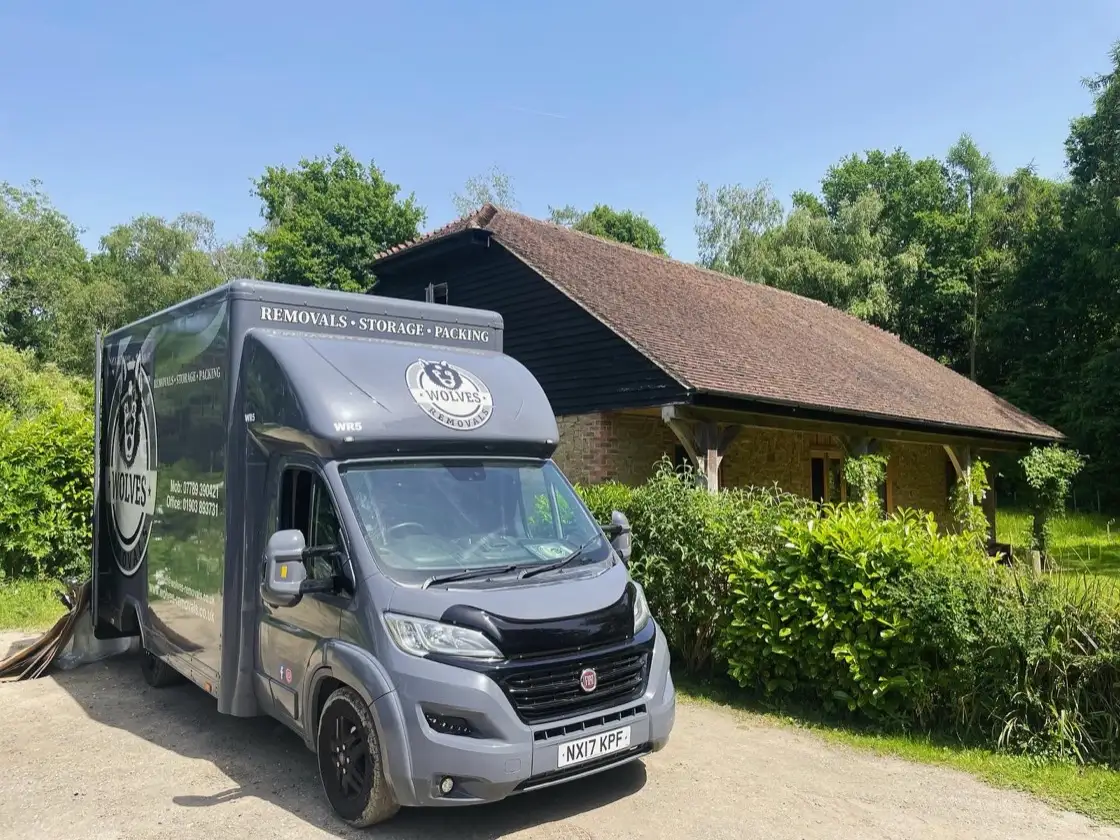
Jack Wolfe
Director, Wolves Removals · Ashington, West Sussex
Jack runs Wolves Removals, which has moved families and businesses across West and East Sussex, Surrey, Hampshire and Kent since 2016 from its Ashington base. The firm is fully insured, Checkatrade-verified and a LAPADA Approved Service Provider for antiques and fine art. More about us, or read our reviews.
Frequently Asked Questions
Yes. This lively university town has a Saxon street plan and chalk downland half a mile from the centre. Trains reach London Waterloo in as little as 32 minutes, and recorded crime is below the England and Wales rate. The main trade-offs are cost, traffic, hills and flooding near the river.
For buyers, yes. By our Land Registry calculation, the town’s median standard-price sale was £470,000 from October 2025 to September 2026. The borough’s average private rent was £1,754 a month in September 2026.
The fastest direct train to London Waterloo takes 32 minutes. Off-peak, two of the direct trains each hour take 32 to 35 minutes, and the quickest leaving between 7am and 8am takes 35 to 37 minutes.
Yes, by national standards. In the year to June 2026 the borough recorded 70.0 crimes per 1,000 residents, against 84.6 across England and Wales. By our calculation, Burpham and Merrow have the lowest rates of the town’s wards.
The old town and Charlotteville suit people who want to walk everywhere, and Onslow Village has hedged lanes and long views. Burpham and Merrow are quieter and, on our police.uk count, have the town’s lowest crime rates. Shalford, Send, Ripley and Compton offer village life.